
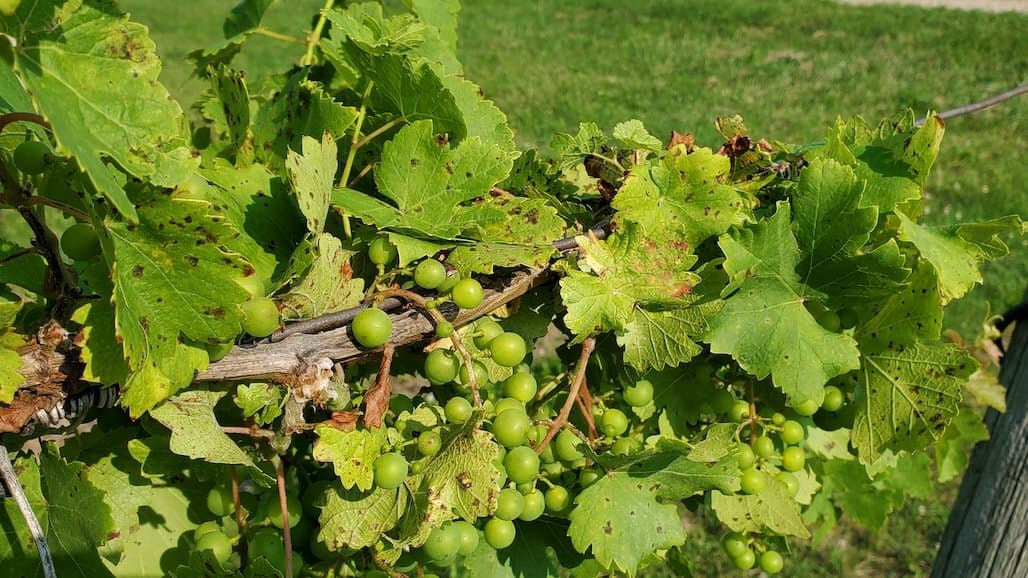
Yellow Speckle Viroid
Pictures of symptomatic Grape Leaves were sent to the Plant Diagnostic Clinic at the University of Missouri on May 13, 2025 from Crawford County. MO. The cultivar was Cabernet franc and the leaves had yellow speckling that suggested that a virus may be the causal agent. The grower first noticed the symptoms on May 9, 2025. Based on the pictures submitted, the symptoms were representative of Yellow Speckle viroid. To confirm the causal agent, I met with the grower on May 21, 2025, and collected symptomatic leaf samples from Cabernet sauvignon (Figure 1) and Cabernet Franc. Results using molecular biology analysis confirmed yellow speckle viroid.

There have been five viroid’s identified that can infect grapevines. These include Hop stunt viroid (HSVd), Citrus exocertis viroid (CEVd), Australian grapevine viroid (AGVd) and Grapevine yellow speckle viroid (GYSVd-1 and GYSVd-2). Our research has identified GYSVd-1 in samples collected from Crawford County, MO. The absence of GYSVd-2 in our samples is likely the result that GYSVd-2 has a low infection rate in cultivated grapevines.
Grapevines infected with GYSVd-1 or GYSVd-2 can display classic yellow speckling on the leaves or remain asymptomatic. Symptom development in infected grapevines has been shown to occur from increased light and temperatures. Interestingly, Grapevine yellow speckle viroid was first observed in greenhouse grown grapevines in Australia. The symptoms of an infected grapevine can be fleeting from year to year. Whereas an infected grapevine may show symptoms for one year and not the next.
Grapevines infected with only yellow speckle viroid typically do not have many negative problems. Issues arise when yellow speckle infected grapevines are impacted by other pathogens that results in a complex interaction that can reduce vine vigor and fruit quality. Currently, little is known how yellow speckle viroid interacts with grapevine viruses and fungal pathogens. To the best of my knowledge yellow speckle viroid has only been found and confirmed in Vitis vinifera. The absence of yellow speckle viroid and other viroid’s that can infect intraspecific cultivars is likely because intraspecific cultivars may likely remain asymptomatic and the fact that few if any states have surveyed for viroid’s using molecular analysis.
Rupestris Speckle
Rupestris speckle is a physiological disorder that causes dark spotting on leaves of intraspecific grape cultivars that have Vitis rupestris in their pedigree. The disorder causes small, circular to irregular, necrotic spots on leaves. In some intraspecific cultivars the necrotic spots may also have a chlorotic halo. Currently the precise cause of the disorder is unknown, but there is speculation that the disorder is caused by stress. These stresses may be abiotic such as drought or graft incompatibility or biotic such as viruses or grapevine trunk diseases. The disorder is believed to cause no impact on production. Being a physiological disorder there are no treatments recommended.

Advertisement
The disorder causes a diverse range of symptoms that is specific to the cultivar. In Missouri, Rupestris speckle is often observed ever year in Chambourcin (Figure 2A) and Valvin muscat (Figure 2B). In Valvin muscat the disorder is sometimes referred to as muscat spot. The symptomology on Chambourcin is very similar to symptoms observed on V. rupestris (Figure 3).

The speckling symptoms can also vary within a cultivar as seen on Frontenac gris (Figure 4). Necrotic spots on grape leaves can be confused with black rot, a fungal disease caused by Guignardia bidwellii (Figure 5) You can differentiate black rot from Rupestris speckle by observing the lesions with a 20X hand-lens. Black rot lesions will have pycnidia forming within the lesion on the upper leaf surface (adaxial) (Figure 6).

It is important that you observe several lesions on leaves as black rot lesions will be in different stages of development. For example, a grape leaf infected with black rot will have some lesions with pycnidia and other lesions with no pycnidia. Also keep in mind the grape cultivar that you are observing. Both Valvin muscat and Chambourcin are susceptible to black rot. — By Dean Volenberg, University of Missouri Grape & Wine Institute

Article By
Dean S. Volenberg
Viticulture Program Leader, University of Missouri Grape and Wine Institute
Dean Volenberg is Viticulture Program Leader and an Extension Assistant Professor in the Division of Plant Science and Technology at the University of Missouri, where he works with the Grape and Wine Institute. His applied research examines how canopy management, vine balance and integrated pest management affect grape quality, and he provides viticulture and winery extension throughout Missouri. He holds a Ph.D. in agronomy and an M.S. in horticulture from the University of Wisconsin.