
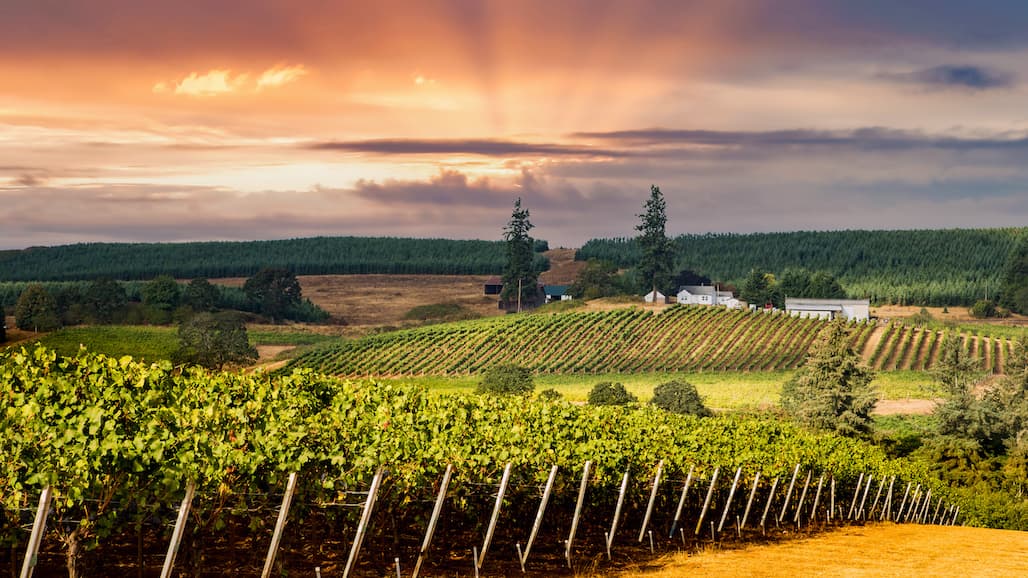
OSU Oregon Wine Research Institute — Oregon plays an important role nationally in wine grape production. In late 2020, a team of Oregon researchers were awarded federal funding to support research in vineyard nutrition as part of a national team in a project entitled High-Resolution Vineyard Nutrition Management. The research focuses on vineyard nutrition and precision agriculture applications for all grape markets in the US and has collaborators from Washington, California, Oregon, New York, and Virginia. Here we provide an update on some of the progress to date from the Oregon team.
Vineyard Trials
The Schreiner Lab and graduate student Santosh Kalauni began trials in 2021 as part of a national effort to better monitor and manage vine nutrition for the grape industry. Three field experiments were designed with commercial vineyard partners to extend prior work conducted in Oregon on vine nutrition. These experiments also serve as test beds for potential new sensors being developed by the engineering team on the project. The experiments are located in the Willamette Valley. They include a nitrogen (N) trial in Chardonnay, a potassium (K) trial in Pinot noir, and a magnesium (Mg) trial in Pinot noir. Each of these trials utilizes a randomized block design with four field replicates. In addition, we just began another experiment in 2022 to examine phosphorus (P) at a Columbia Valley Cabernet Sauvignon vineyard in Washington.
2021 Results
The nutrient additions did not alter vine productivity based on crop yield or pruning weights at our trial sites in the first year. This is an expected outcome because of the time it takes for nutrient additions to impact a perennial crop such as grapes. Soil applications of 0, 20, or 40 pounds per acre of N tested in Chardonnay altered some measures of nutrient status of the vines in 2021, but effects were not yet of considerable magnitude. For example, bloom leaf blade N was increased by the high N rate to 2.74% of dry weight (DW) compared to 2.45% in the no N Controls, but petiole N did not differ at bloom. At veraison, leaf blade N did not differ among treatments, but petiole N was slightly higher in the high N vines (0.53% DW) than in the no N vines (0.42% DW). We suspect larger differences in vine N status will be observed in the coming year as we continue these experiments. One interesting finding from this N experiment showed that whole cluster N status at lag-phase was a good predictor of must YAN levels at harvest with greater than 80% accuracy. It will be interesting to see how robust lag-phase cluster N samples will be in future years and across other grape production systems. We tested this idea of cluster N since many growers are removing clusters at lag-phase for crop estimation practices.
Potassium is being studied in a Pinot noir vineyard with a history of very low K status. We applied heavy doses of K to the soil in the vine row (0, 184, 356 pounds actual K per acre), and we included a foliar K treatment for comparison. The K applications did not increase leaf or petiole K at bloom or veraison, nor did they increase must K concentrations or alter the pH of the must in year 1. However, we found that K levels in dormant season canes (pruning wood samples) increased in all three K treatments compared to the no K control. We expect to see increases in K status in leaf and petiole samples in the coming year as we applied similar doses of K to the soil again this spring 2022.
We are using foliar sprays to correct Mg deficiency at a Pinot noir vineyard that has shown Mg deficiency symptoms every year over the life of the vineyard. We compared two foliar sprays of MgSO4 applied three times at 10 or 20 pounds per acre (supplying a total of 3 or 6 pounds actual Mg per acre) to an untreated control. We chose to focus on foliar applications since prior results in the Willamette Valley and elsewhere using high rates of MgSO4 applied to soil have not been effective. In this present work, the high rate of Mg increased leaf blade Mg levels at veraison but did not alter petiole Mg, as shown in previous studies from the Schreiner Lab. However, the low and high rate of foliar Mg reduced the number of leaves with Mg deficiency symptoms by more than 75% at harvest. Mg applications did not affect must Mg levels.
Advertisement
Precision Viticulture Research
The Washington State University engineering team, including the labs of Dr. Manoj Karkee and Dr. Qin Zhang, will begin collecting multi-spectral data from Oregon vineyard trials in 2022. They developed a proximal sensing system used in Washington State University trials in the project, and they are working to adapt it for use within our local projects. The sensors use image capture and analysis of multi-spectral wavelengths. The goal is to determine which wavelengths will be useful in detecting tissue nutrient concentrations at the field level for N, P, K, and Mg.
Vineyard Nutrition Meta-Analysis
Dr. Patty Skinkis and Dr. John Woodill also make up the Oregon team involved in this national project. They are conducting a meta-analysis on past vineyard nutrient datasets from other research projects and producers to identify nutrient impacts on yield, quality, or economics. The Statewide Crop Load Project from the Skinkis Lab and data sets from the Schreiner Lab have been used to analyze economic production models. More data from the High-Resolution Vineyard Nutrition trials will be gathered across the US as the project continues and used to inform the model. In the end, we hope to develop a well- informed model to determine vineyard nutrition needs from a productivity and economic perspective based on different grape markets and regions. The biggest challenge is getting complete data sets and determining how to interpret the data with respect to product quality and not just end-of-season crop yield. Once the model is defined, we plan to have some form of a decision-support tool created to help growers make better nutrient management decisions.
Stay Tuned for More Information
Our work in Oregon vineyards for this national project will continue through the 2023 growing season. Together, we hope the data from our Oregon projects, combined with the efforts of the project team across the US, will help us develop better monitoring tools and protocols for more precise vineyard nutrient management; and possibly tools for more rapid evaluation of nutrient levels in vines than is currently possible with tissue tests. We share results from this work and others across the nation through our website and social media (Instagram, LinkedIn, and Twitter). — By Santosh Kalauni, Paul Schreiner, Patty Skinkis & John Woodill, Oregon State University