
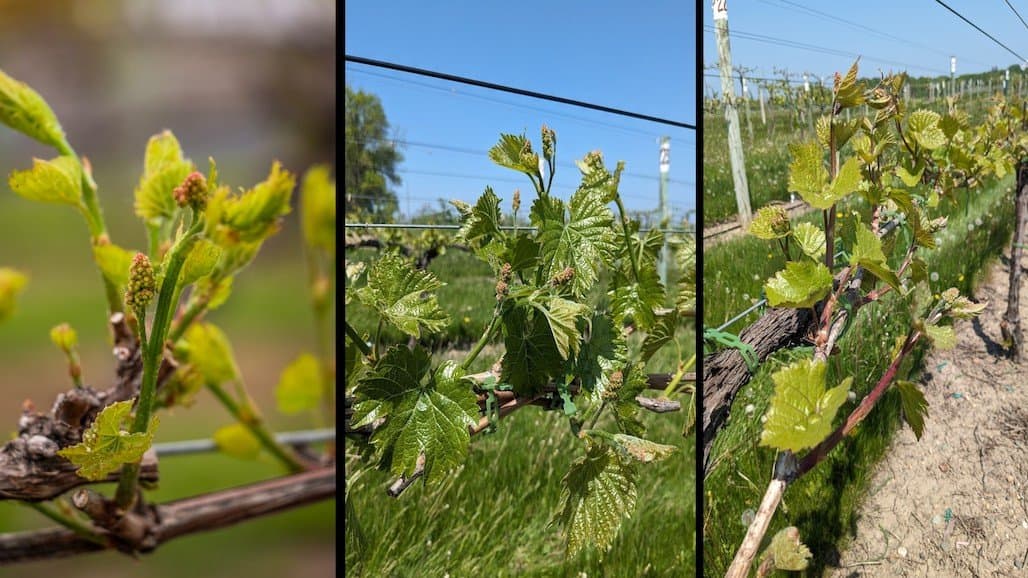
Grapes in the southern half of Minnesota are moving along quickly, many ranging from 4-6 in. tall showing clusters at the bud stage.
Canopy management
At this growth stage, shoots are still tender enough to be removed by hand. Cold climate grapes are typically thinned to 6-8 shoots per linear foot of canopy. Secondary shoots can also be thinned. Secondary shoots are visible when there are two shoots emerging out of the same node (see picture below), in which their emergence is more common in some cultivars than others.
At this growth stage, shoots are still tender enough to be removed by hand. Cold climate grapes are typically thinned to 6-8 shoots per linear foot of canopy. Secondary shoots can also be thinned. Secondary shoots are visible when there are two shoots emerging out of the same node (see picture below), in which their emergence is more common in some cultivars than others.

Diseases
Growers can continue routine conventional or organic fungicide spray programs to proactively manage fungal pathogens at this time. To learn more about grape diseases and appropriate fungicides to apply, refer to the Midwest Fruit Pest Management guide.
Growers can continue routine conventional or organic fungicide spray programs to proactively manage fungal pathogens at this time. To learn more about grape diseases and appropriate fungicides to apply, refer to the Midwest Fruit Pest Management guide.

Insect pests
Grape phylloxera: The UMN Horticultural Research Center reported some early signs of Grape phylloxera (Dactylosphaera vitifoliae) on grape foliage.
About:
- Grape phylloxera is an insect pest that can affect both the roots and foliage of grapes, but most cold climate interspecific hybrid grapes grown in Minnesota are mostly susceptible to foliar damage.
- Grape phylloxera exhibits multiple generations per growing season and the first generation, known as “crawlers”, emerge in the spring from mother eggs on the trunk and cordons and migrate to the newest grape foliage, potentially leading to 40-50 galls per leaf. Thus, the University of Minnesota recommends managing the crawlers as the most critical management stage, especially when growing more vulnerable cultivars like Frontenac.
- For vineyards with an extensive history dealing with Grape phylloxera, time insecticide applications during early gall detection. UMN Extension recommends conventional growers use Danitol (pyrethroid) or Movento (systemic) for conventional grape phylloxera management. To learn more about grape phylloxera and management, visit this UMN webpage and refer to the Midwest Fruit Pest Management guide. — By Madeline Wimmer, University of Minnesota Extension Educator
Article By
Madeline Wimmer
Fruit Production Extension Educator, University of Minnesota Extension
Madeline Wimmer is a fruit production extension educator with University of Minnesota Extension, based at the regional office in Rochester, where she works with growers across the state on apples, grapes, honeyberries and strawberries. She studied at the University of Wisconsin-Madison, working with cold-climate wine grapes during her graduate years, and has worked in vineyards in Wisconsin and Missouri. Her programming focuses on building the confidence of new growers producing fruit in Minnesota conditions.