
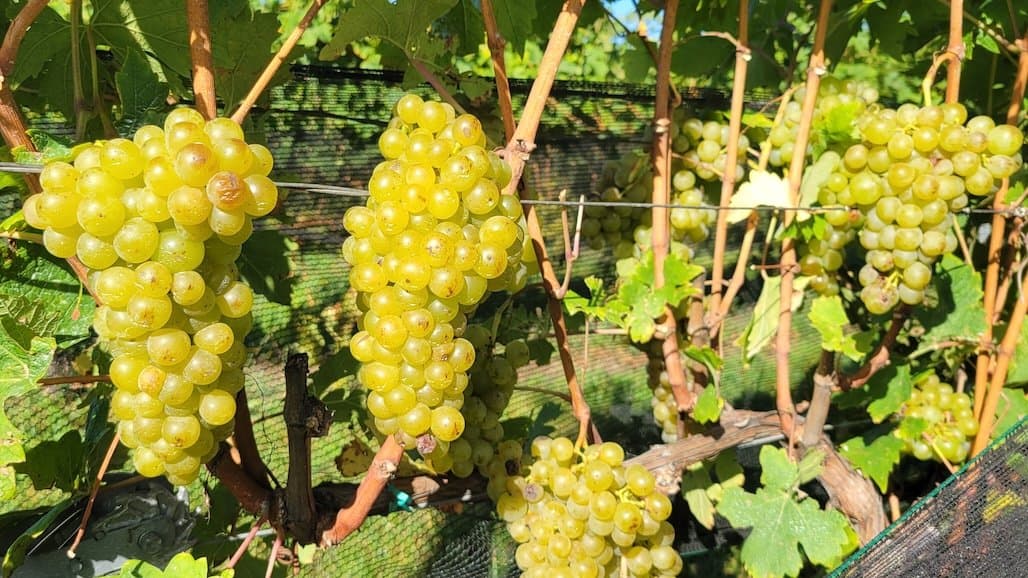
University of Michigan Viticulture Extension — In southwest Michigan, juice grape harvest has begun. Niagara harvest began Monday, Sept. 29. Concord harvest is slated to begin Oct. 9. Wine grape harvest continues. Tonnage continues to be lighter than expected with sugars accumulating on pace. Acidity is slow to drop in many varieties, potentially due to the dehydration most vineyards are seeing. The warm, dry weather is providing growers with the opportunity to extend hang time to continue ripening.
In northern Michigan grape clusters are currently progressing through the modified E–L phenological stages 37and 38. Stage 37 represents berries that are approaching full ripeness but are not yet mature, while stage 38 corresponds to berries at full ripeness and harvest-ready.

Some vineyards producing sparkling wine have already begun harvesting, and in a few cases, sparkling varieties have already been picked. Early ripening cultivars are also being harvested across parts of northwest Michigan.
Meanwhile, later ripening varieties will remain on the vine longer to achieve the desired fruit quality before harvest. This variability highlights the asynchronous ripening patterns across cultivars in the region and underscores the importance of close monitoring to guide harvest decisions.
In the Tip of the Mitt American Viticulture Area, harvest is underway for hybrid cultivars. Hybrid cultivars are expected to be harvested within the next seven days or so especially as the risk for frost increases. Marquette is testing at 25 brix and 3 pH. Vinifera in the region continues to ripen with expected harvest dates in the next two to three weeks. Zweigelt is testing at 19.7 brix, 3.07 pH. Riesling is testing at 17 brix and 2.92 pH. Botrytis and sour rot have been noted in some vineyards.
In southeast Michigan, most grape harvest has concluded, even in cooler parts of the region.
Advertisement
Horticulture
End-of-season strategies to accelerate grape ripening in cool, humid conditions
As the 2025 harvest season advances across Michigan, regional differences in timing are becoming clear. Vineyards in southwest Michigan are now nearly a month into harvest, while those in the southeast are about three weeks along. These early progressions highlight the strong influence of heat accumulation and seasonal variability on fruit development across the state.
In cooler northern regions, harvest is just beginning, and growers face the familiar challenge of achieving full fruit maturity under declining fall temperatures and persistent humidity. Once daily averages dip below 50 F (10 C), sugar accumulation slows sharply, leaving clusters more vulnerable to disease pressure and delayed ripening. Understanding where each region stands in harvest progression helps guide timely management decisions to accelerate ripening and protect fruit quality in the final stretch of the season.
Targeted leaf removal
One of the most effective short-term strategies is selective leaf removal around the fruit zone. Removing a modest number of leaves—particularly on the sun-exposed side of the canopy—enhances light penetration and airflow. This not only promotes sugar accumulation but also reduces humidity, lowering the risk of Botrytis and sour rot. In Michigan’s late-season climate, the risk of sunburn from increased exposure is minimal.
Cluster thinning
Advertisement
Even late in the season, cluster thinning can improve ripening uniformity. Removing underdeveloped or diseased clusters allows the vine to concentrate its limited resources on the remaining fruit. While sugar gains may be modest, thinning helps ensure marketable maturity and reduces the risk of off-flavors in wine. Research shows that as little as 5% rot-affected fruit can negatively impact wine aroma and flavor, making this practice essential for preserving sensory quality.
Water management
Managing water inputs is critical during the final ripening phase. In irrigated vineyards, reducing or withholding water near harvest can curb vegetative growth and concentrate sugars and secondary metabolites. In regions with frequent rainfall, improving soil drainage is key. Techniques like deep ripping or subsoiling between rows can break up compacted layers, enhance infiltration and reduce waterlogging—ultimately protecting fruit integrity.
Selective harvesting
Staggered harvests may offer a practical solution. Picking compromised clusters first allows healthier fruit to remain on the vine for additional ripening. This approach helps salvage quality while minimizing disease spread.
Advanced techniques
In challenging seasons, some growers may consider pre-pruning—cutting fruiting canes before harvest—to redirect assimilates and concentrate sugars through partial dehydration. Applied to roughly half the fruiting canes, this technique can yield a mix of fully ripe and dehydrated fruit, enhancing wine complexity through blended chemical profiles.
Advertisement
Mechanical airflow enhancement
In especially humid sites, tools like compressed air leaf removers, sprayers, wind machines or fans can improve airflow and delay rot onset by drying out the fruit zone. Ultimately, while cooler temperatures limit the vine’s natural ripening capacity, a thoughtful combination of light management, cluster selection, water control and harvest timing can help growers make the most of the final weeks and safeguard fruit quality.
Preparing for harvest in Michigan wine vineyards
The final weeks before harvest are pivotal for Michigan wine grape growers. Fruit composition shifts rapidly, disease pressure intensifies, and coordination with wineries becomes essential. Strategic preparation ensures grapes are harvested at peak quality and delivered in optimal condition for winemaking.
Monitoring fruit maturity
Harvest decisions rely on both chemistry and sensory cues. Sugar levels typically range from 19-25 Brix, with sparkling wine bases harvested earlier at 18-20 Brix. Titratable acidity and pH should be tracked closely, as cool nights can shift acid balance quickly. Sensory indicators, such as seed and skin color, tannin texture and berry weight, offer critical insight into ripeness. Sampling should be representative, with about 100 berries or 20 clusters per block. Yeast-assimilable nitrogen is also vital, especially for aromatic whites and high-sugar reds, as low yeast-assimilable nitrogen can lead to sluggish fermentations.
Canopy and disease management
Advertisement
Maintaining an open canopy is essential. Leaf removal should leave no more than one or two layers around clusters to enhance light exposure, airflow, and spray coverage, reducing the risk of Botrytis and sour rot.
Harvest sanitation and food safety
All harvest tools and containers should be cleaned and sanitized before use. Damaged equipment must be replaced, and sanitation records maintained for compliance. Diseased or insect-damaged clusters should be culled in the field or at sorting tables.
Winery coordination
Clear communication with wineries is crucial. Confirm target maturity, container needs and delivery schedules. Wineries should ensure all equipment is sanitized and ready. Early morning harvests help preserve freshness, while shaded field storage limits oxidation. Efficient transport and clear block labeling streamline winery operations and maintain traceability.
Bird damage and ripening risks
Bird damage is a serious concern during the ripening period, especially from veraison through late fall. Without control measures, crop losses can reach up to 95% in red varieties and 60% in white. MSU Extension outlines a range of mitigation strategies—from netting and acoustic deterrents to robotic lasers and environmentally safe chemical repellents. Bird injury also increases susceptibility to fungal diseases like Botrytis and sour rot. For more on this topic, see “Bird damage reduction strategies utilizing viticultural practices.”
Advertisement
Diseases
In the southwest, cluster rots are the primary focus. If powdery mildew is the only concern, there are a number of products that are effective (FRAC codes 3, 7, 11, 13, U8, 50, and U13 as well as sulfur). Combining fungicides from different FRAC classes should also be effective while helping with resistance management.
Botrytis infections are continuing to develop. The most effective products for botrytis are site specific and prone to resistance development. A Michigan Grape Fact Sheet is available for managing botrytis bunch rot.
Remember that as you choose a fungicide, check the guide for potential phytotoxicity of certain sprays on Concord grapes especially (this has been particularly noted for fungicides like Revus Top). Phytotoxicity risk is higher with high temperatures and quickly growing vines. Also, there is a significant phytotoxicity risk with specific contact products such as copper and sulfur for Labrusca type grapes (Concord and Niagara).
Insects
Monitoring traps for grape berry moth indicate very low activity in southwest Michigan, with two vineyards having caught zero moths, and the others having one to 10. This indicates the end of the fourth generation of this pest, with much lower activity than last week. We also found no evidence of egglaying or newly hatched larvae, which further shows the shorter day length has signaled that grape berry moth need to prepare for winter by pupating.
The only other pest species observed were a low count of vinegar fly adults and larvae, and some yellow jackets feeding on ripe berries. There were no other insect pest species reported.
Advertisement
Thank you for a great season with the SAM Tool

The Sustainable Ag Management (SAM) Tool team extends a warm thank you to all the grape growers and researchers who used the SAM Tool this season. Your input has been invaluable in refining the tool to better support vineyard operations.
As the growing season wraps up, we’re now scheduling onboarding sessions in November for growers who would like to get started ahead of next year. The off-season is an ideal time to explore the system, organize vineyard information, and prepare for spring activities.
The SAM Tool continues to evolve as a practical resource that simplifies recordkeeping, supports compliance, and strengthens vineyard management. Many growers have found it helps save time and money while improving day-to-day efficiency.
Thank you for helping make this a successful year — and to those joining soon, welcome aboard! Together, we’re advancing smarter and more sustainable vineyard management.
Website: https://sustainableag.msu.edu
Email: SustainableAg@msu.edu