
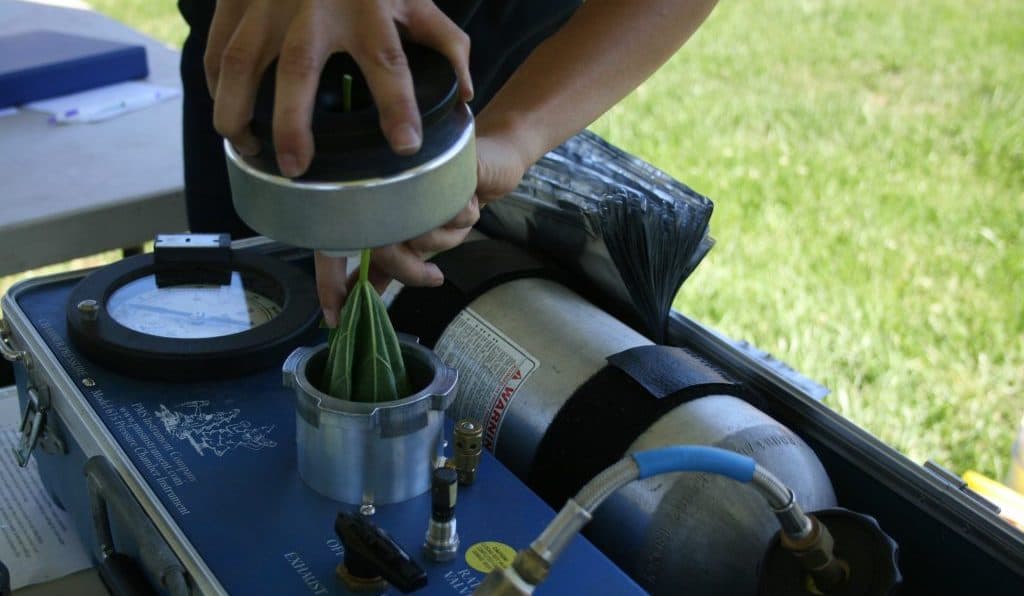
Nearly 40 years after its first documented use in grapevines, the pressure chamber (“pressure bomb”) remains the gold standard tool for determining vine water status. Whether one chooses to measure midday leaf water potential (ψleaf) or midday stem water potential (ψstem), the pressure bomb informs us how stressed our vines are and helps us decide whether to irrigate. A review of the various pressure bomb measurement methods (and other plant-based techniques for assessing of plant water status) can be found in the recently published open-access review by Levin and Nackley (2021).
The limitations of the pressure bomb are not lost on those who are frequent users of the tool. Notably, they center around the labor-intensive nature of its deployment and the limited temporal window in which one has to make the measurement. Thus, the bomb limits the practitioner to a narrow snapshot of vine water status, and by extension, the total number of snapshots one can gather (e.g., vines in a block or blocks in a vineyard).
One solution may be that a vineyard manager chooses to measure various blocks over the course of a week. However, environmental conditions across sites may be highly variable day to day – sometimes conditions may be cooler and more humid, while other sites may be warmer and drier. Furthermore, even if other environmental conditions are optimal for making a measurement (e.g., a bright sunny day), relative differences in temperature and aridity across measurement days or locations will influence vine physiology, and ultimately the data. So, is there a way to somehow normalize pressure bomb data collected across a broad range of environmental conditions?
Under non-limiting (i.e., non-stressed) conditions, the rate of water loss from plant leaves is a passive process driven by a potential energy gradient. The sun’s energy vaporizes liquid water inside leaf cells, and the vapor fills the intercellular air spaces inside the leaf. As a result, these intercellular spaces are saturated with water vapor and maintain relative humidity (RH) of ~100%. However, the atmosphere just outside of the leaf has a significantly lower RH. The magnitude of this difference (between the inside and outside of the leaf) gives rise to the driving gradient and is known as the vapor pressure deficit (VPD). The greater the VPD, the greater the gradient and rate of water loss. More background on water movement through grapevines can be referenced in Levin (2018a).
In their seminal paper, Williams and Baeza (2007) showed that both midday leaf and midday stem water potentials are negatively correlated to VPD under well-watered conditions (Figure 1).

In other words, as VPD increases (environment gets warmer and drier), vine water status decreases. Thus, given a known VPD, one could calculate a theoretical “non-stressed baseline” ψleaf or ψstem. This value would represent the vine water status at the point of measurement if that vine were well-watered (and no supplemental irrigation would raise the water status further).
Advertisement
 Calculating the non-stressed baseline value at the time of measurement can provide important context to the actual measured value of ψleaf or ψstem itself. Measurements obtained across sites or days can be normalized for the environmental conditions at the measurement time, aiding in interpretation.
Furthermore, the difference between the measured value (absolute stress) and the calculated baseline value can be leveraged to audit and optimize an irrigation management program by providing a value of relative stress.
It is important to note that the non-stressed baseline value and/or the difference between measured and baseline values do not take the place of the absolute measured value. Rather, these supplemental data serve to provide context for the measured value. The absolute value of ψleaf or ψstem is truly a marker for what the vine is experiencing at that moment, and it still has consequences on vine physiology. For example, a leaf water potential value of -1.5 MPa (or -15 bars) means the same thing to a grapevine no matter the environmental context – it is representative of severe water stress (Levin 2018b). However, that value measured under high VPD conditions should be interpreted slightly differently from that measured under low VPD conditions.
Under high VPD conditions, water potentials are decreased as vines become more stressed, so even fully irrigated vines may be mildly stressed. In Figure 1 ψleaf falls below -1.0 MPa (-10 bars) when VPD increases above 6 kPa. This means that no matter how much irrigation is applied (and soils are at field capacity), vines will still be experiencing mild stress under these environmental conditions. So, while the low value may cause concern, it may not support the decision to irrigate. Conversely, under low VPD conditions, a measurement of -1.5 MPa (-15 bars) would suggest that vines are not only severely stressed on an absolute level but also that they are severely stressed relative to the present conditions. Ultimately, this situation may trigger a decision to irrigate.
 One important takeaway from these relationships is that when the environmental conditions are extremely stressful for grapevines (i.e., VPD > 6 kPa), they will be experiencing some stress no matter the level of moisture in the soil. Under these conditions, supplemental irrigation will accomplish very little. Therefore, it is important to use the non-stressed baseline value to contextualize and normalize the absolute value of ψleaf or ψstem to improve irrigation management. — By Dr. Alec Levin, Assistant Professor (viticulture), OSU-Southern Oregon Research and Extension Center (SOREC)