
Precipitation is the story so far.
Rain is an expected feature of spring in Ohio, and that’s not much of a debate. In fact, the 30-year average cumulative precipitation for May in Wooster is 3.73”. This year, we’ve received nearly 1” above that average with 4.59” of total cumulative precipitation (https://newa.cornell.edu Wooster Hort 2 station). The real uncanny part is the number of days that it has rained this month: 22 of 31 days. That’s right, we logged measurable precipitation for 71% the month.
…and the fun hasn’t stopped. June to date has logged an additional 2.18” across 4 total days of rainfall so far, which is nearly 57.6% of the 30-year average monthly rainfall, with more forecast over the next 7 days.
Temperature and Growing Degree Days (GDD)
Not only was May rainy, but it was also cool. The average daily temperature in May was 57.6 F, which is 2.6 F cooler than the 30-year average. Despite below average temperatures, cumulative annual GDD (720, base 50 F, January 1 to June 12) remains similar to, albeit slightly below, the 30-year average (787).
Phenology
Reports across the state place phenology anywhere from pea-size (Southeast Ohio) to pre-bloom and early bloom (Northeast Ohio).
Advertisement
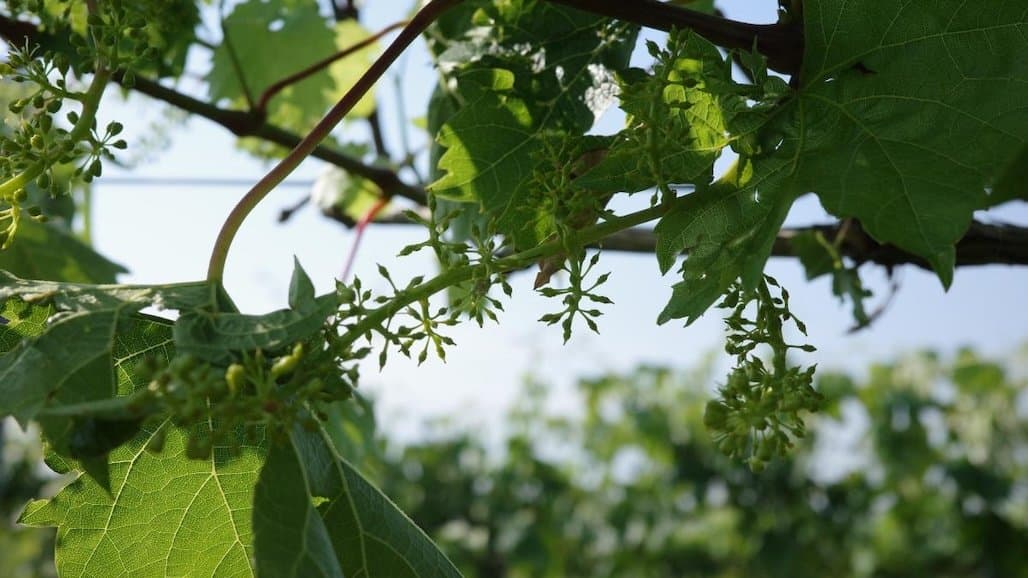
In Wooster, we are moving through bloom this week, with some early hybrid cultivars (e.g., Itasca) near fruit set, while others (e.g., Cab Franc) are just beginning bloom (Figure 1, Table 1).

Table 1. 50% bloom date and GDD for select cultivars at Hort 2, Wooster, OH.
|
Cultivar |
50% bloom date |
GDD |
|
Cabernet Franc |
12-Jun |
720 |
|
Chardonnay |
13-Jun |
— |
|
Regent |
12-Jun |
720 |
|
Albariño |
12-Jun |
720 |
|
Aromella |
13-Jun |
— |
|
Traminette |
10-Jun |
681 |
|
Chambourcin |
13-Jun |
— |
|
Marquette |
9-Jun |
674 |
|
Itasca |
5-Jun |
613 |
|
Petite Pearl |
9-Jun |
674 |
|
Clarion |
9-Jun |
674 |
|
Jupiter |
9-Jun |
674 |
Canopy management
With the rain and recent warming temperatures, shoots have reached nearly 3’ in length (Figure 2). Shoot and wire positioning Vinifera for VSP and suckering/thinning have been ongoing over the past several weeks. We are waiting to comb the high-wire shoots on the hybrids until the fruit starts to weigh the shoots down and shoot tips become less prone to breaking (Figure 3).
Advertisement


Disease updates
Cool, rainy conditions in May meant Phomopsis in several cultivars at Unit 2 (Figure 4). In more southern regions, many are also seeing Anthracnose stem and leaf infections (Figure 5). Reminder: we are still well-within the critical window for flower and fruit protection for all major diseases. This period over the next several weeks are the most important time of the season to ensure broad spectrum coverage using your best fungicides for preventative protection. For fungicides registered for grapes and disease efficacy, see: Midwest Fruit Pest Management Guide.


Insect management
Advertisement
It is right about time to start turning our attention to Grape Berry Moth (GBM). This is one of the handful of insects that can cause direct crop loss from fruit damage (Figure 6).
The other major insect to begin to start monitoring for is Japanese beetles. These foliage feeders can get out of hand quickly if allowed to accumulate large populations.
Some minor pests to monitor for include gall makers (grape cane gallmaker, grape tumid gallmaker), flea beetle larvae, and leafhoppers.
Scouting and monitoring (using GDD-based tools and traps) are the best means for deciding when insect control is warranted. In Wooster, we typically use fewer than 5 insecticide applications all season (this includes pre-harvest sour rot management sprays) by regular monitoring and providing well-timed and appropriate insecticide applications. Excessive use of insecticides may cause secondary pest infestations, including mites and mealybugs.
— By: Maria Smith, HCS-OSU


