
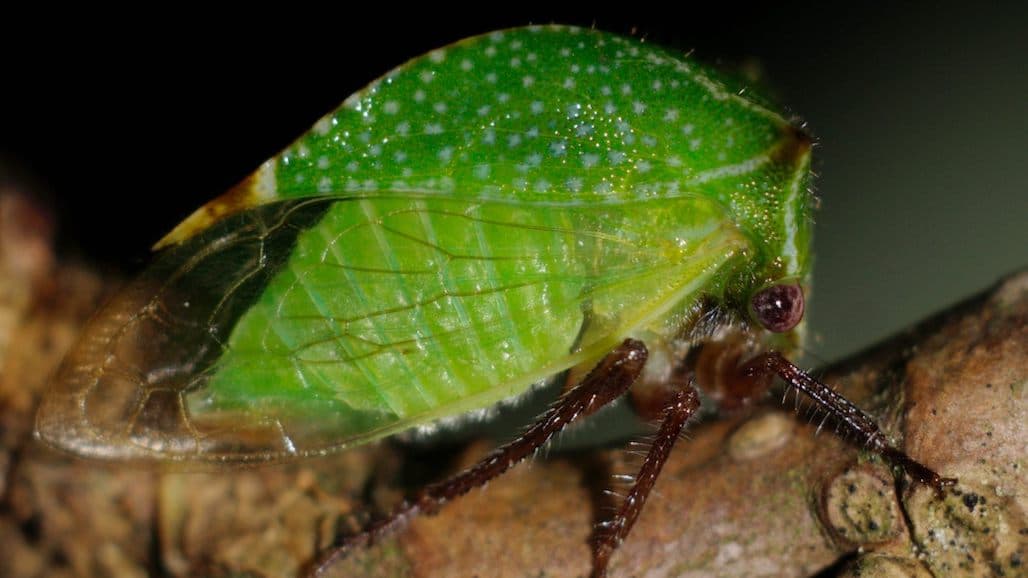
Grapevine red blotch virus appears to be spreading in Oregon vineyards, which raises the question of which insects may contribute to its spread. In 2016, a treehopper insect, the three-cornered alfalfa hopper, was identified as a vector in California, and is believed to be an important component of spread of this virus. Adults of this species were found in 2016 in commercial vineyards in southern Oregon, and closely related treehopper species (genus Tortistilus) were found in southern Oregon and the Willamette Valley (R. Hilton Pers Comm.).
Treehopper feeding in grapes can result in the girdling of stems and leaf petioles of grapevines (Figure 1) and subsequent reddening of foliage distal to the girdle in red winegrape cultivars (Figure 2). In white-fruited winegrape cultivars, girdling can cause chlorosis. Searching for this distinctive damage was also used to assess treehopper activity. Mapping and spatial analysis of treehopper damage in vineyards indicated that the damage was concentrated on vineyard edges. By identifying girdles in your vineyard, you know you have populations of treehoppers that may spread the virus. It is therefore important to be aware of this risk by looking for girdles which is an indication of active treehopper populations.
The southern Oregon and Willamette Valley treehopper populations are believed to have one generation per year. Evidence of treehoppers was observed on a variety of host plants, including pear, apple, grape, oak and rose. Eggs of both Tortistilus species were found in the springtime at different densities within the stems (T. wickhami) and buds (T. albidosparsus) of non-cultivated plants surrounding vineyards. As the season progressed, immature treehoppers were found on vetch and wild carrot surrounding and within vineyards. Girdles were observed and adults were first collected in 2017 in the Willamette Valley on July 20, and the first girdles were found in vineyards as early as July in southern Oregon
Different sampling techniques were used and compared: sweep netting, beat trays, motorized vacuuming, and visual searches. Overall, visual searching of girdled leaves has been by far the most effective method for determining presence of adult treehoppers. Motorized vacuum sampling was attempted in 2017 and efficiently captured immature insects. Egg-laying was observed in September in vineyards and surrounding habitat.
Observations and monitoring for treehopper activity is an important component of Integrated Pest Management that will help growers to better understand the risk of red blotch spread in their vineyards and thereby maintain high crop quality. — By Daniel T. Dalton, PhD Candidate, Dept. of Horticulture, OSU, Richard J. Hilton, Faculty Research Assistant, Southern Oregon Research and Extension Center, Dept. of Horticulture, and Dr. Vaughn Walton, Professor, Horticultural Entomologist, Dept. of Horticulture, OSU.