
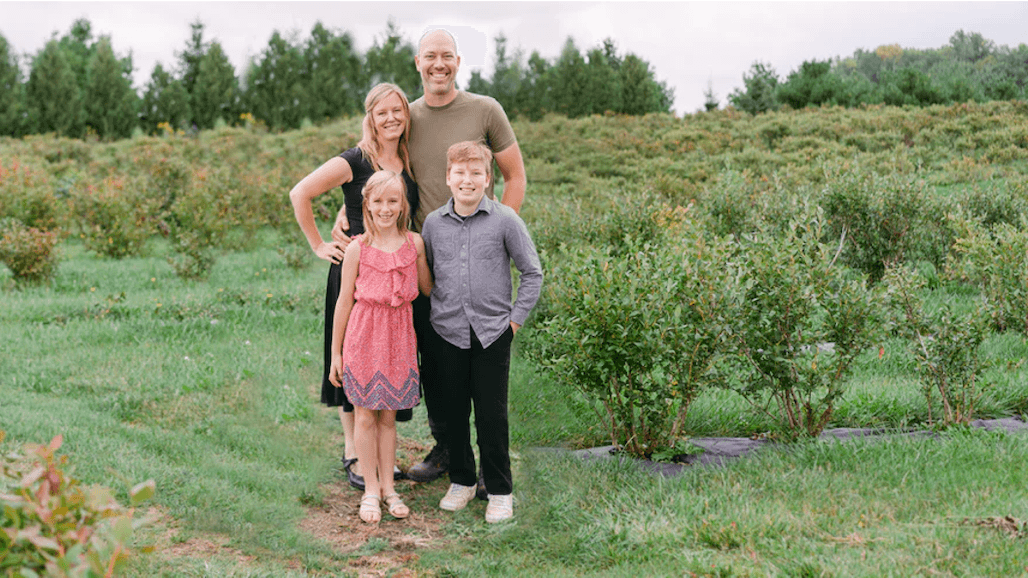
Aaron Wills is the founder and operator of Little Hill Berry Farm, an organic diverse farm offering fruit crops like blueberries, strawberries, raspberries and is now dipping into growing table grapes.
Wills’ interest in table grape production began after having a conversation with Erin Treiber, a table grape researcher at the University of Minnesota who was looking for an organic grower to trial some newer bred table grape soon-to-be-released cultivars (i.e., cultivated varieties). His vines are in the establishment phase and have yet to bear fruit, sitting at about two years old. He’s growing four different cultivated varieties (i.e., cultivars) and is excited about the production prospects.
Anyone who has grown multiple fruit crops understands that growing grapevines is a completely different management experience than cultivating fruit trees, woody fruiting shrubs, or perennial plants like strawberries. For example, Wills has previously trellised his fall-bearing raspberries, which are cut down completely at each season’s end, so there is minimal training required. In contrast, grapes typically have multiple training phases which establish vine anatomy: 1) trunk(s), 2) cordons (arms) and 3) spurs, for spur pruned vines (see grapevine image below for reference).

Wills looked back at the trellis construction and establishment process so far as fairly easy. He felt like the grapes grew with little effort and were less sensitive to water deficits than the other fruit crops he grows. This is in part because of how deep grape roots can grow compared with blueberries and especially so with strawberries. Table grapes and other grapes still require more weed management when they’re young and Wills is taking that on by laying down agricultural fabric with a 1ft by 1ft hole where each vine was planted. To complement this, Wills is practicing fertigation and has fully equipped his trellis with dripline irrigation. He’s training his vines in a High Wire Cordon fashion, with the shoots draping downward. By the end of this second year, his vines are now touching the top of his trellis training wire, positioned at 5.5 feet, a wire that exists for the purpose of upholding the fruiting zone and the weight that comes with it.
For other crops, Wills offers a U-Pick model of sales or weekly subscriptions for buyers to pick up day-neutral strawberries during a large part of the growing season (day-neutral strawberries being different from the June-bearing strawberries most Midwesterners are used to finding in their local markets and U-Pick farms during June and July). Wills is still thinking about how to best market and sell his table grapes in the future, which tend to ripen simultaneously and in a smaller window of time.

Advertisement
Table grape breeding and research in Minnesota
The University of Minnesota is well known for their breeding successes related to cold climate wine grapes including the release of ‘Marquette’, ‘La Crescent’, ‘Frontenac’, and newer releases like ‘Itasca’ and ‘Clarion’. While lesser known, cold climate table grapes have also been included in breeding since 2015, with most grant projects funded by the Minnesota Department of Agriculture.
The UMN’s oldest table grape ‘Bluebell’ was released back in 1944. However both UMN and viticultural pioneer, Elmer Swenson took effort in a second revival of grape breeding in the Upper Midwest, leading to the joint release of a red seeded table grape known as ‘Swenson Red’ in 1977. Grape breeding has come a long way since and UMN is anticipating releasing more table grapes to the market in the future.

Unlike grapes bred for wine production, desirable traits in table grapes include seedless berries, thinner skin, a crisp texture, and good color development. They also tend to have large berries and loose clusters. Most importantly for cold-climate production, disease resistance, cold tolerance, and fruit storability are key breeding targets.
Table grapes are an exciting crop of interest to Minnesota growers because of their wide variety and ability to impact larger consumer audiences, including children and folks who abstain from alcohol. They can really complement a whole fruit or vegetable farming operation looking for a new crop to fill in sales during the late summer and fall when most of the harvest occurs. With all that has been done to produce table grapes in the Upper Midwest, the future looks ‘berry’ promising. — By Madeline Wimmer, Extension Educator, fruit production, University of Minnesota
Article By
Madeline Wimmer
Fruit Production Extension Educator, University of Minnesota Extension
Madeline Wimmer is a fruit production extension educator with University of Minnesota Extension, based at the regional office in Rochester, where she works with growers across the state on apples, grapes, honeyberries and strawberries. She studied at the University of Wisconsin-Madison, working with cold-climate wine grapes during her graduate years, and has worked in vineyards in Wisconsin and Missouri. Her programming focuses on building the confidence of new growers producing fruit in Minnesota conditions.