
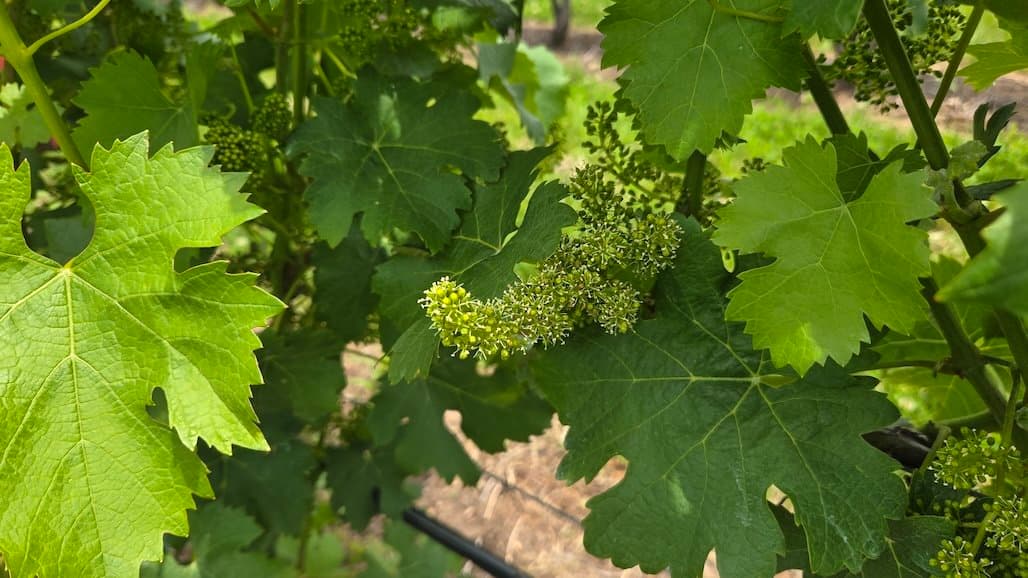
Cabernet Franc’ grape cluster at the flowering stage at Black Star Vineyard in Leelanau County, Michigan, on June 26. Photo by Vahid Rahjoo, MSU Extension.
Michigan State released its July 1 grape scouting report, with development varying greatly between regions, the emergence of Japanese beetles in the Fennville region and black rot and Phomopsis the north.
Vine Development in Southwest and Southeast Michigan
In Southwest Michigan, grape bloom is complete. Juice grapes and early hybrid cultivars are at berry touch, while some tight-clustered varieties are beginning bunch closure. Many Vitis vinifera cultivars are near pea-size berry stage.
In Southeast Michigan, all grape cultivars are sizing up. Tight-clustered cultivars such as ‘Petite Pearl’ are approaching bunch closure, and juice grapes are approximately 9–10 mm in diameter.
Northwest Michigan
Across Northwest Michigan, most Vitis vinifera cultivars are currently at the flowering stage, with shoots reaching the top wire. Given the current environmental conditions, growers should remain vigilant with bloom-time disease management
Advertisement
Tip of the Mitt
Hybrid cultivars are in various stages from bloom to fruit set. Vitis vinifera cultivars are just beginning bloom. Rose chafers have been observed in most vineyards, and black rot and Phomopsis pressure have increased significantly over the past week, with signs of both diseases noted in some vineyards.
For reference, see MSU Extension’s grape growth stages chart.
Viticulture
Optimizing canopy architecture and maintaining robust soil health are foundational to sustainable vineyard performance, high fruit quality, and disease mitigation. The following is a consolidated guide to these essential early- and mid-season viticulture practices.
Early-Season Canopy and Crop Management
Timely interventions dictate the structural balance of the vine. In warmer regions, these practices begin at 10–15 inches of shoot growth, while cooler northern sites should prepare to execute them as pre-bloom development progresses.
Advertisement
- Shoot thinning: Removing weak, excess or non-count shoots establishes optimal canopy density. This improves light interception, enhances airflow and supports uniform cluster development. Read more.
- Shoot positioning: Promptly securing shoots vertically prevents tangling and guarantees effective spray penetration.
- Crop load assessment: While major thinning typically occurs post-fruit set, early removal of clearly excessive or poorly positioned clusters reduces resource competition and improves fruit set consistency.
- Pre-bloom leaf removal: In high-vigor sites, targeted early leaf removal in the fruiting zone improves the microclimate and reduces future disease pressure, particularly for compact-clustered cultivars.

Cool-Climate Optimization
Growers in regions with compressed growing seasons, such as Northwest Michigan, must use strategic interventions to maximize ripening and counter harvest-season rot complexes.
Early Hedging
Cutting shoots shortly after they surpass the top wire redirects vine energy away from vegetative expansion and toward fruit development. Research from Michigan State University (MSU) indicates this practice preserves highly photosynthetically active leaves and promotes beneficial lateral growth that drives late-summer ripening. Timing is critical: hedging too early can trigger an overly dense canopy, especially in vigorous cultivars.
Cluster-Zone Leaf Removal and Mechanization
Advertisement
Managing the microclimate directly around the fruit is the most impactful technique for protecting tight-clustered varieties like Pinot Noir and Riesling. Read more.
To bolster economic sustainability, the industry is transitioning to mechanical systems like the Collard compressed-air leaf remover. Beyond stripping leaves, targeted bursts of air blow out necrotic floral tissue. This critical secondary benefit eliminates the nutrient base where latent Botrytis spores typically overwinter before spreading post-veraison.
Recommended reading from MSU Extension
Soil Health
A resilient soil structure ensures consistent vine performance and nutrient use efficiency under volatile weather conditions.
Advertisement
- Cover cropping: Row-middle cover crops reduce surface erosion, build soil organic matter, and stimulate beneficial microbial activity.
- Organic amendments: Incorporating compost improves the soil’s water-holding capacity and establishes a slow-release nutrient reservoir throughout the growing season.
- Compaction prevention: Avoiding heavy machinery traffic on wet soils preserves soil aeration and protects root integrity. This is especially vital during periods of rapid root growth and peak nutrient uptake.
Pest Management
Diseases
Fungicide programs should prioritize materials with strong protectant and systemic activity, while rotating modes of action to manage resistance. Products in FRAC groups 3 (DMIs) and 11 (QoIs), often used in premixes, remain key options for powdery mildew and black rot, while multi-site protectants such as captan (M4) or mancozeb (M3) provide additional coverage and help reduce resistance risk.
For downy mildew, materials in FRAC groups 40, 45, 21 and 11, as well as phosphorous acid products, are effective choices when conditions favor infection. Careful selection and rotation of these chemistries, combined with thorough coverage during bloom, are essential to protect developing clusters and limit early-season disease establishment.
Insect Pests
First reports of Japanese beetles in vineyards this week in the Fennville region, so depending on vine susceptibility, these may need some control. We are also seeing the grape berry moth model reach the time predicting the START of grape berry moth egglaying for Generation 2 in Southwest Michigan. Selective insecticides targeting eggs should be applied soon, with sprays targeting larvae waiting until after the July 4 weekend, for Southwest Michigan vineyards. More details can be found in our article posted here: Unusual timing for wild grape bloom this spring, and implications for grape berry moth control.
Advertisement
Weeds
Summer weed management in vineyards should focus on scouting and controlling weeds that escaped spring preemergence herbicide programs or emerged after residual activity began to decline. This is especially important during hot, dry periods because weeds compete with vines for soil moisture and nutrients at a time when vines may already be under heat and water stress. Young or newly planted vineyards are especially vulnerable, but even established vineyards can lose vine vigor when large weeds are allowed to remain in the undervine strip.
Growers should scout vineyard floors now and identify which weeds are present, their size, and whether they are broadleaves, grasses or perennial weeds. Summer annual weeds such as pigweed, lambsquarters, ragweed, foxtails, crabgrass, barnyardgrass and other annual grasses may continue to emerge through the summer, especially after rainfall or irrigation. Perennial weeds such as Canada thistle, bindweed, quackgrass, yellow nutsedge and dandelion may also be present and often require repeated management. If spring residual herbicides were applied earlier in the season, some breakthrough is expected as those products begin to lose activity, especially where weed pressure is high or where rainfall patterns affected activation or persistence.
Postemergence herbicides are most effective when weeds are small and actively growing. During heat waves or droughty periods, weeds may be stressed, dusty, hardened off or less actively growing, which can reduce herbicide performance. If possible, target applications before weeds become large and avoid waiting until weeds are moisture-stressed. Good spray coverage is especially important for contact herbicides. Also consider vine stress: avoid drift, use directed sprays, and do not allow herbicides to contact grape leaves, green shoots, green bark, suckers or young vines.
Several postemergence options are listed in the 2026 Michigan Fruit Management Guide for grapes. In established vineyards, glufosinate can be used as a directed application to actively growing weeds and is generally more effective on smaller weeds; higher labeled rates may be needed for larger weeds. Paraquat provides contact control of emerged annual weeds, but coverage is critical and it must be kept off green grape tissue. Aim can be used for burndown of small broadleaf weeds and is often most useful when weeds are small. Venue can be tank-mixed with glyphosate or glufosinate to improve desiccation of small broadleaf weeds. Gamma may also be used in grapes established at least two years and should be applied with another postemergence herbicide to improve control of established weeds. Glyphosate can control annual and perennial weeds, but it must be used with caution in grapes because contact with leaves or green shoots can cause serious injury, and applications after bloom should generally be avoided based on label and guide precautions.
For grass-only problems, products such as Fusilade DX, Poast, or Assure II may be used when grasses are actively growing and within the labeled size range. These products will not control broadleaf weeds, so growers should match the herbicide to the weed spectrum present. For mixed broadleaf and grass populations, a broader postemergence program or tank mix may be needed where labeled and appropriate.
At this point in the season, adding another residual herbicide may only be useful if the label allows the timing and if rainfall or irrigation is expected to activate the product. In established vineyards, some residual options such as Prowl H2O may be applied during the growing season where labeled, but residual herbicides will not control large emerged weeds by themselves. If emerged weeds are present, a labeled burndown partner is needed.
Advertisement
Always follow the product label for grape age restrictions, rates, adjuvants, maximum seasonal use, preharvest intervals, restricted-entry intervals, tank-mix compatibility and crop-safety precautions. Apply all postemergence herbicides as directed sprays to the vineyard floor and avoid contact with green grape tissue. Rotate herbicide sites of action and integrate mowing, cultivation, cover crops or other nonchemical tactics where possible to reduce herbicide-resistance risk and improve long-term vineyard floor management.
Read the full scouting report here. — Story Contributed by Michigan State University