
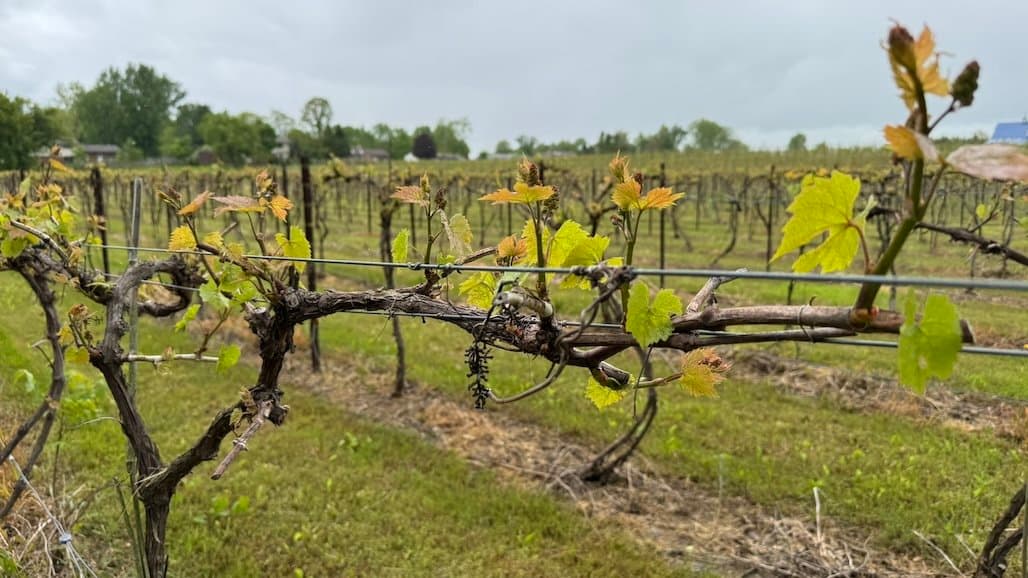
Michigan State University Extension — At the close of May in southern Michigan, juice grapes and early hybrid wine grapes grew to over 12 inches of shoot growth, with clusters expanding and elongating. Early bloom has been seen on Brianna cultivar at the Southwest Michigan Research and Extension Center. Early hybrids and Vitis vinifera cultivars are around 6-12 inches of growth.
In northern Michigan, all Vitis vinifera varieties passed budburst, but development has been slow due to recent cool weather. Most vines are now showing about two fully expanded leaves. While growth is progressing, it remains early in the shoot development stage, and vines are still vulnerable to environmental stress, particularly late spring frost. Continue to monitor weather conditions and apply frost protection measures as needed. Tracking phenology at this stage helps inform timely decisions for pest management, fertilization and canopy work. For reference, see MSU Extension’s Grape Growth Stages chart.
In the Tip of the Mitt American Viticultural Area (AVA), hybrid cultivars are still at the 1- to 3-inch shoot stage, while Vitis vinifera varieties are still at bud break, with some showing two or three small leaves. The cooler weather is providing for a gradual entry into the 2025 growing season. It’s time to begin applying protective fungicides.
In southeast Michigan, Concord’s grape shoot extension has been observed as long as 18 inches in Hartland. Measurements taken on May 22 at Youngblood’s in Ray Township showed 8-inch shoot growth in Frontenac, 4-inch shoot growth in Petite Pearl and 8-inch shoot growth in Marquette.
Horticulture
Accurate assessment of vineyard nutrient requirements is essential for optimizing vine health, fruit quality and yield. Implementing soil testing and petiole analysis provides critical data to inform nutrient management strategies. A quality soil test or a previous year’s petiole analysis is important in understanding which nutrients the vineyard needs.
Petiole analysis should be done at bloom and veraison, and at specific stages of vine development when nutrient concentrations in the petiole are most stable and representative of the vine’s overall status. The most widely recommended timing for petiole sampling is at full bloom, which occurs when approximately 70% of the flowers on a cluster are open. This stage provides the most reliable data for key nutrients such as nitrogen, phosphorus, potassium and micronutrients.
Advertisement
An alternative or complementary sampling period is at veraison, when about half of the berries on a cluster begin to change color or soften. Sampling at veraison can be useful for monitoring nutrients like potassium, magnesium and boron later in the season or for tracking changes in nutrient dynamics over time.
The accuracy of petiole analysis depends heavily on sampling the correct leaf position. At full bloom, the petiole should be collected from the leaf that is directly opposite the basal grape cluster, typically the fourth to sixth leaf from the base of the shoot. This leaf is considered physiologically mature and reflective of the vine’s nutrient reserves at bloom. At veraison, petioles should be collected from recently matured leaves, generally located around the fifth to seventh leaf from the shoot tip.
A representative sample should include petioles from a sufficient number of vines across the block or variety, ideally 60 to 100 petioles collected from at least 20 to 25 randomly selected, healthy vines. Leaves chosen for sampling should be free of visible disease, pest damage or physical injury. To avoid contamination, petioles should be collected with clean tools and placed in a paper bag (not plastic) to allow for air drying. Samples should be clearly labeled with block, variety, date and phenological stage, and should be dried or delivered promptly to a testing laboratory.
When properly conducted, petiole analysis provides a clear snapshot of vine nutritional health and supports informed management decisions that contribute to balanced growth, fruit development and overall vineyard sustainability.
Soil tests evaluate nutrient content, pH levels and other soil characteristics, offering insights into the soil’s fertility and potential nutrient deficiencies. Petiole analysis, which involves testing the leaf of grapevines, directly measures the nutrients absorbed by the plant, providing a more immediate understanding of the vine’s nutritional status. Regular monitoring through these methods allows for timely adjustments to fertilization practices, ensuring optimal nutrient availability throughout the growing season.
During the early stages of vine growth, particular attention should be given to the application of nitrogen, zinc and boron, as these nutrients are vital for shoot development and flowering. Potassium and magnesium are also important during this period, supporting various physiological processes within the vine.
Nitrogen plays a crucial role in vegetative growth and fruit development. However, its application must be carefully managed:
Advertisement
- Excessive nitrogen: Can lead to delayed flowering and excessive vegetative growth, potentially compromising fruit set and quality.
- Insufficient nitrogen: May result in reduced vine vigor, leading to lower yields and diminished fruit quality.
Therefore, precise nitrogen management, informed by soil and petiole analyses, is essential to balance vegetative growth and fruit production effectively. Shoot thinning will begin in the southern vineyards in the next week or two. Shoot thinning is an important canopy management tool to improve air circulation, minimize disease pressure, reduce shading, and improve spray penetration. The right time for shoot thinning time is when the shoots are 5-12 inches long.
For more comprehensive information on shoot thinning and other early season vineyard management practices, please refer to the article, “Early season vineyard management.”
Diseases
During this time of the year, the primary diseases of concern for grape growers are phomopsis, black rot, anthracnose and powdery mildew. If you’re seeking detailed insights into pre-bloom fungicide options and the effects of rain on disease spread, refer to previous grape scouting reports or exploring an article on early-season disease management. It’s worth noting that some growers have recently observed isolated cases of downy mildew infections in northern vineyards. Southern vineyards have been seeing early infections of phomopsis and are beginning to see black rot lesions.
As bloom continues in southwest Michigan, start choosing fungicides that control all the fruit diseases. For example, with downy mildew we are most concerned with fruit infection at this time and sprays should be timed prior to bloom and at bloom for optimal control. Downy mildew is caused by a fungal-like organism, so many site-specific systemic fungicides that target other spring diseases do not work on downy mildew. Effective fungicides for downy mildew include products in FRAC codes 4, 11, 21, 40 and 45 as well as phosphorus acid salts and some biologically-based products.
With the exception of powdery mildew, these spring disease infections typically require rain events. It only takes 0.1 inches of rain above 50 F to trigger a possible infection. Viticultural practices that reduce canopy wetness such as good irrigation timing, leaf removal and good weed management can reduce many of these diseases in a vineyard. Typically, DMIs (FRAC 3), captan and EBDCs (FRAC M3) are effective for phomopsis, black rot and anthracnose.
Advertisement
Insects
Grape berry moth adult populations are increasing across the state. First generation berry moth larvae have been detected in grape clusters in recent weeks in southwest Michigan. Based on the degree day model for this pest, the start of the second generation egglaying is expected in late June/early July in southwest Michigan, proceeding later into July at further north locations.
The first signs of grape cane gallmaker activity were detected this week in southwest Michigan. Grape tumid gallmaker infestation, rose chafer feeding and sightings of potato leafhopper are still present. Protect susceptible cultivars, especially in young vineyards where potato leafhopper can stunt shoot growth. Neonicotinoid insecticides such as Assail and Admire Pro can provide protection against potato leafhopper, rose chafer and tumid gallmaker if present in the same vineyard site.
Scouting in action: Using the SAM Tool to track frost and spray effects
A grower recently shared an example of how the Sustainable Agriculture Management (SAM) Toolsupported timely vineyard scouting and documentation during a critical management window.
Brian Seipel, who manages Marquette grapes in Ingham County, used the SAM Tool to record weather-related damage and spray outcomes in early May. After applying Manzate Pro-Stick on May 4 and 7, a frost warning hit his area on the morning of May 9. Temperatures dropped to 32 F with high humidity—conditions that posed a risk to tender 1-2-inch shoots.
Following a reapplication of Manzate and a burst of bright sunshine, two challenges emerged in the vineyard:
Advertisement
- Frost damage
- Leaf cupping (possibly from photo-toxicity)
Seipel used the SAM Tool mobile app to document both events at once by uploading a photo taken with his phone, which captured geolocation data and was pinned on the vineyard map. This real-time documentation helped him track both spray-related and weather-related events.
“The best was when I had a chance to intelligently record the events in the SAM Tool,” said Seipel. “I could take advantage of my phone’s location and camera settings to record the GPS location the photos were taken. As a result, I was able to capture and upload evidence of both events in one photo. It was simple and easy. I could also see the notes I uploaded with the pictures that is pinned to the map. As a result, I will not only have record of these important events as lessons learned, but be reminded that sustainable agriculture is dynamic, with multiple challenges that are simultaneously in play. So, it’s good to have the help of technology to plan and keep score!”

This example illustrates how the SAM Tool can support:
- Scouting with photographic and geolocated documentation.
- Timely decision-making based on spray history and environmental events.
- Recordkeeping of frost events, phytotoxicity risks, spray timing and auto-recorded weather conditions.
- Future planning with mapped data and notes.
To learn more or get help getting started with the SAM Tool, visit the SAM Tool website or contact Karen Chou at chouk@msu.edu.