
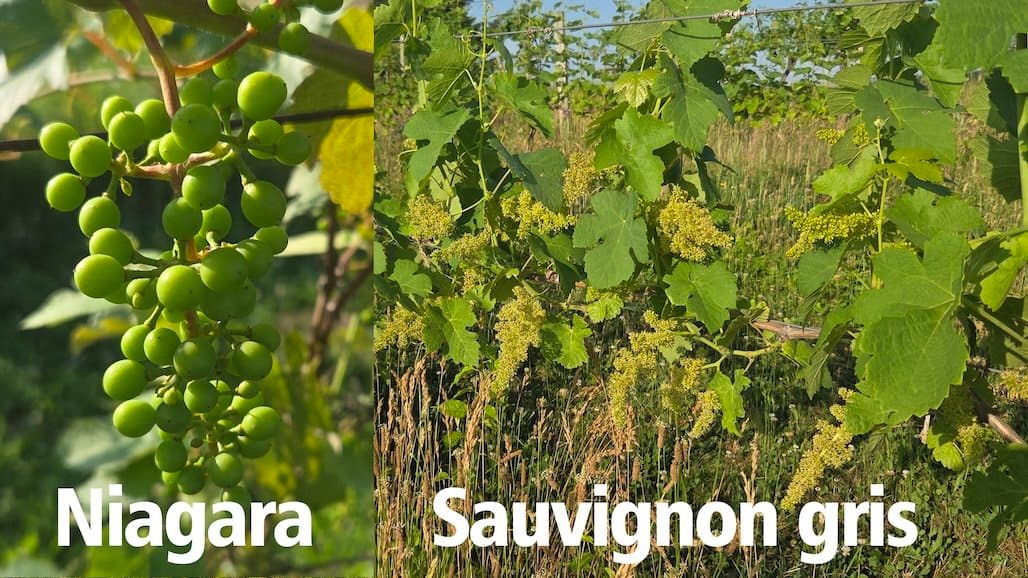
As of June 25th in southern Michigan, grape bloom is ending. Juice grapes are between buckshot and pea berry, as are some early hybrids like Geneva Red and Marquette. Late hybrid cultivars like Traminette and Regent are blooming now. Most vinifera varieties are between full and late bloom. Shoot positioning and tucking are continuing. Some growers are talking about leaf removal around the cluster zone.
In northern Michigan, a recent stretch of warm, humid weather has spurred a rapid response from vinifera cultivars. The heat over the past week has significantly accelerated shoot elongation and cluster development. Shoots now measure between 15 and 30 inches and are approaching the top wire, with 10 to 12 fully developed leaves per shoot. Grape clusters continue to expand, indicating strong reproductive progress.
Vines are at E-L Stage 17. The window for shoot thinning is closing, as late removal at this stage can damage spur positions or rejuvenated cordons. By this point, shoot bases begin to lignify, becoming woody and resistant to removal, making it difficult to pull shoots cleanly without tearing bark or wood. Such damage can harm the underlying renewal structures.
Additionally, tendrils may have wrapped around adjacent shoots or trellis wires, so removing shoots now may disturb neighboring growth or compromise the vine’s framework. These injuries not only reduce vine longevity but also create entry points for disease and affect next season’s productivity.
Nutrient management should also be prioritized during this period of rapid vegetative and reproductive growth. Although earlier cool soil conditions may have delayed uptake, the recent warm weather has reactivated root function, improving nutrient absorption and supporting healthy vine development.
Tracking phenology is crucial for making timely decisions on pest management, fertilization and canopy work. For detailed staging, refer to Michigan State University Extension’s Grape Growth Stages chart.

Advertisement

In the Tip of the Mitt AVA, hybrid cultivars are in various stages of development with some cultivars at the immediate pre-bloom stage to full bloom. Vitis vinifera cultivars are in the 10-16 inch growth stage to immediate pre-bloom. Rose chafers have been noted in some vineyards. Rainfall and high humidity has increased the risk for phomopsis, black rot and powdery mildew infection. Phomopsis and black rot has been noted in some vineyards.


In southeast Michigan, bloom has largely concluded and fruit is beginning to set, with some varieties at buckshot and others approaching pea size. Grape berry moth counts in Lenawee and Macomb counties dropped from the previous week. There is high powdery mildew risk this week from June 28-July 1. There is some risk for downy mildew infection June 25-26 and some risk for grape black rot infection June 25-28.


Advertisement
Horticulture
Accurate assessment of vineyard nutrient requirements is essential for optimizing vine health, fruit quality and yield. Implementing soil testing and petiole analysis provides critical data to inform nutrient management strategies. A quality soil test or a previous year’s petiole analysis is important in understanding which nutrients the vineyard needs.
Petiole analysis should be done at bloom and veraison, and at specific stages of vine development when nutrient concentrations in the petiole are most stable and representative of the vine’s overall status. The most widely recommended timing for petiole sampling is at full bloom, which occurs when approximately 70% of the flowers on a cluster are open. This stage provides the most reliable data for key nutrients such as nitrogen, phosphorus, potassium and micronutrients.
An alternative or complementary sampling period is at veraison, when about half of the berries on a cluster begin to change color or soften. Sampling at veraison can be useful for monitoring nutrients like potassium, magnesium and boron later in the season or for tracking changes in nutrient dynamics over time.
The accuracy of petiole analysis depends heavily on sampling the correct leaf position. At full bloom, the petiole should be collected from the leaf that is directly opposite the basal grape cluster, typically the fourth to sixth leaf from the base of the shoot. This leaf is considered physiologically mature and reflective of the vine’s nutrient reserves at bloom. At veraison, petioles should be collected from recently matured leaves, generally located around the fifth to seventh leaf from the shoot tip.
A representative sample should include petioles from a sufficient number of vines across the block or variety, ideally 60 to 100 petioles collected from at least 20 to 25 randomly selected, healthy vines. Leaves chosen for sampling should be free of visible disease, pest damage or physical injury. To avoid contamination, petioles should be collected with clean tools and placed in a paper bag (not plastic) to allow for air drying. Samples should be clearly labeled with block, variety, date and phenological stage, and should be dried or delivered promptly to a testing laboratory.
When properly conducted, petiole analysis provides a clear snapshot of vine nutritional health and supports informed management decisions that contribute to balanced growth, fruit development and overall vineyard sustainability.
Advertisement
Soil tests evaluate nutrient content, pH levels and other soil characteristics, offering insights into the soil’s fertility and potential nutrient deficiencies. Petiole analysis, which involves testing the leaf of grapevines, directly measures the nutrients absorbed by the plant, providing a more immediate understanding of the vine’s nutritional status. Regular monitoring through these methods allows for timely adjustments to fertilization practices, ensuring optimal nutrient availability throughout the growing season.
During the early stages of vine growth, particular attention should be given to the application of nitrogen, zinc and boron, as these nutrients are vital for shoot development and flowering. Potassium and magnesium are also important during this period, supporting various physiological processes within the vine.
Nitrogen plays a crucial role in vegetative growth and fruit development. However, its application must be carefully managed:
- Excessive nitrogen: Can lead to delayed flowering and excessive vegetative growth, potentially compromising fruit set and quality.
- Insufficient nitrogen: May result in reduced vine vigor, leading to lower yields and diminished fruit quality.
Therefore, precise nitrogen management, informed by soil and petiole analyses, is essential to balance vegetative growth and fruit production effectively. Shoot thinning will begin in the southern vineyards in the next week or two. Shoot thinning is an important canopy management tool to improve air circulation, minimize disease pressure, reduce shading, and improve spray penetration. The right time for shoot thinning time is when the shoots are 5-12 inches long.
The period from pre-bloom to fruit set presents a narrow yet crucial window for cultural practices that directly influence fruit quality, vine balance and long-term productivity. The following are key strategies recommended by leading viticulturists, including the Michigan State University’s viticulture team, with a focus on early leaf removal, shoot thinning and trunk cleaning as part of a precision canopy management approach.
Effective canopy management begins in the pre-bloom phase when the vines start to direct energy toward flowering and initial fruit development. The primary goals at this stage are to:
Advertisement
- Optimize sunlight exposure.
- Improve air circulation.
- Balance vegetative growth with reproductive load.
Shoot thinning is often the first intervention. By removing excess shoots, especially non-fruitful or weakly growing ones, growers reduce canopy density and reallocate vine resources toward stronger shoots. According to the Michigan State University viticulture team, optimal shoot densities (15-18 shoots per meter of cordon) significantly enhance fruit exposure and uniformity.
One of the most impactful practices during this period is early leaf removal, specifically removing basal leaves around the fruit zone before bloom or shortly thereafter. Research conducted by the Michigan State University viticulture tram across multiple vineyards and years in northwest and southwest Michigan have demonstrated that:
- Early defoliation improves fruit zone microclimate and reduces incidence of cluster rot (e.g., Botrytis).
- It modifies fruit set by reducing the number of berries per cluster, effectively decreasing compactness and improving airflow.
- Phenolic composition, especially flavonoids and anthocyanins, improves due to better light penetration.
Early leaf removal is particularly valuable in cool, humid climates like Michigan where tight clusters are prone to disease. Trials with Merlot and Pinot noir varieties reported an increased berry skin-to-pulp ratio and enhanced aroma potential when defoliation was implemented pre-bloom.
Often overlooked, trunk cleaning is critical for disease management and vine longevity. Trunks should be inspected and cleared of basal suckers and adventitious shoots that harbor pathogens and divert energy. Coupled with sucker removal, these sanitation practices create a cleaner, more efficient vine structure, easing future operations such as spraying and harvest.
For more comprehensive information on shoot thinning and other early season vineyard management practices, please refer to the article, “Early season vineyard management.”
Advertisement
Diseases
During this time of the year, the primary diseases of concern for grape growers are phomopsis, black rot, anthracnose and powdery mildew. If you’re seeking detailed insights into pre-bloom fungicide options and the effects of rain on disease spread, refer to previous grape scouting reports or exploring an article on early-season disease management. It’s worth noting that some growers have recently observed isolated cases of downy mildew infections in northern vineyards. Southern vineyards have been seeing early infections of phomopsis and are beginning to see black rot lesions.
As bloom continues in southwest Michigan, start choosing fungicides that control all the fruit diseases. For example, with downy mildew we are most concerned with fruit infection at this time and sprays should be timed prior to bloom and at bloom for optimal control. Downy mildew is caused by a fungal-like organism, so many site-specific systemic fungicides that target other spring diseases do not work on downy mildew. Effective fungicides for downy mildew include products in FRAC codes 4, 11, 21, 40 and 45 as well as phosphorus acid salts and some biologically-based products.
With the exception of powdery mildew, these spring disease infections typically require rain events. It only takes 0.1 inches of rain above 50 F to trigger a possible infection. Viticultural practices that reduce canopy wetness such as good irrigation timing, leaf removal and good weed management can reduce many of these diseases in a vineyard. Typically, DMIs (FRAC 3), captan and EBDCs (FRAC M3) are effective for phomopsis, black rot and anthracnose.
Insects
With fruit set and early berry growth underway, grape berry moth larvae have been observed in southwest Michigan vineyards, indicating first generation egglaying occurred during bloom. These detections have mostly been along wooded borders and are easy to detect by checking clusters. Look for the webbing of berries connected by silk. In red cultivars the berries will turn color prematurely, making them even easier to see (see Photo 8).
Treatment for berry moth at this time of the season can overlap with populations of leafhoppers, rose chafers and tumid gallmakers, so a thorough check of the vines is useful at the end of June to confirm they have low levels of any insect pests. We have also seen infestations by thrips in some vineyards this spring, causing feeding damage on the young berries. If a treatment is required, there are multiple registered options that can control these different types of insects. Check the Michigan State University Fruit Pest Management Guide(bulletin E154) for recommendations. A hard copy or a PDF version can be ordered from shop.msu.edu.
Advertisement
To improve timing of controls for grape berry moth, MSU Enviroweather developed a degree day-based model to help identify times when second and first generation egglaying starts. These timings can be useful for identifying when to apply insecticides, and is based on the model which tracks degree days (base 47 F) from the biofix entered by the user. This biofix is the date of bloom of wild grape (Vitis riparia) in your region. The estimated dates for the 2025 season are listed in following table. If you don’t have a date for bloom from your own vineyard, use these as a guide. With these dates set for biofix, we expect the target timings of 810 degree days for egg-active insecticides and 910 degree days for contact insecticides to be after the July 4 weekend. We will update these targets next week as we get closer.

Let’s put Michigan wine on the map!
Michigan winemakers are invited to contribute wines for the upcoming American Society for Enology and Viticulture – Eastern Section annual meeting, taking place July 8-10, 2025. This national event offers a valuable platform to highlight the quality, diversity and innovation of Michigan’s wine industry to a broad audience of researchers, educators and industry professionals.
Wines of all styles are welcome. If direct shipping is not feasible, Esmaeil Nasrollahiazar from Michigan State University Extension has offered to personally transport donated wines to the conference.
The final day to contribute is Thursday, July 3.
For more information or to arrange a donation, please contact Sarah Lowder at sarah.lowder@uga.edu or 704-574-4285, or Esmaeil Nasrollahiazar at nasroll2@msu.edu or 231-922-4621. — By Esmaeil Nasrollahiazar, Mike Reinke, Paolo Sabbatini, Rufus Isaacs, Logan Fairchild, Timothy Miles, Cheyenne Sloan, Derek Plotkowski, Karen Chou, and Vahid Rahjoo, Michigan State University Extension; Derrick Vogel, Folklor Wine and Cider
