
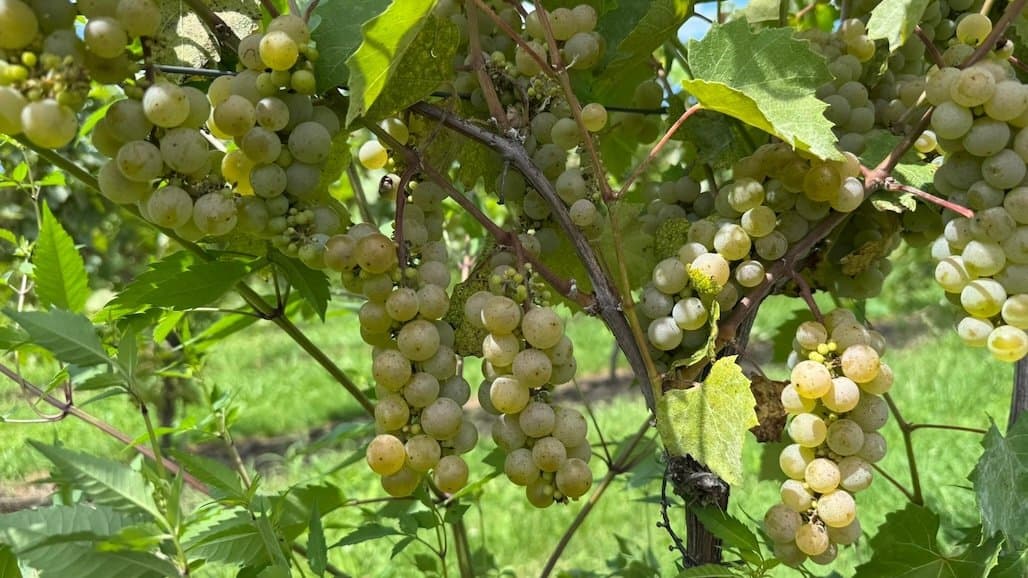
Michigan State University Extension — As of the last week of August, veraison is complete for most hybrids in southwest Michigan. Some late varieties such as Regent are still developing color. Many Vitis vinifera varieties are in the middle of veraison as well. Harvest is expected to begin at the start of September.
In northern Michigan, grape clusters are progressing through the modified E–L phenology stages 33 and 34. Development varies by cultivar:
- Early ripening varieties are entering the onset of veraison (Stage 34), where berries begin to soften and sugar accumulation has just started.
- Later-ripening varieties remain at Stage 33, with berries still hard and green and no visible signs of softening.
This variation highlights the natural spread in ripening across cultivars in the region, with early varieties moving into the initial stages of ripening while later varieties are still in the lag phase of berry growth.

Photo 1. Early grape varieties at Brys Estate Vineyard showing color change, berry softening and sugar accumulation. Photo by Esmaeil Nasrollahiazar, MSU Extension.
In the Tip of the Mitt American Viticulture Area (AVA), veraison is underway in most hybrid cultivars with earlier varieties showing 50-75% complete veraison. Earlier ripening vitis vinifera is beginning veraison, and we’re still waiting on later ripening cultivars. The risk for black rot is diminishing while the risk for powdery and downy mildew remain low to moderate.
Advertisement

Photo 2. Zweigelt grapes at veraison at Folklor Wine & Cider in Charlevoix, Michigan, on Aug. 19, 2025. Photo by Derrick Vogel, Folklor Wine & Cider.

Photo 3. L’Acadie Blanc grapes at veraison at Folklor Wine & Cider in Charlevoix, Michigan, on Aug. 19, 2025. Photo by Derrick Vogel, Folklor Wine & Cider.
In southeast Michigan, Concord is at veraison while more varieties undergo harvest. The table grape Canadice was picked in Britton, Michigan. Growers are letting wine grapes hang while weather conditions are good, but harvest is likely to start over the weekend. There is no anticipated risk for downy mildew or black rot this week, but powdery mildew infection risk is severe all week from Aug. 26-Sept. 2. Downy mildew can show up as on oily looking spot when it is not sporulating.

Photo 4. Concord grapes at veraison at Spicer Orchards in Hartland, Michigan, on Aug. 25, 2025. Photo by Derek Plotkowski, MSU Extension.
Advertisement

Photo 5. Marquette grapes with bird netting at Youngblood Vineyard, Ray Township, Michigan, on Aug. 21, 2025. Photo by Derek Plotkowski, MSU Extension.
Horticulture
Pre-veraison leaf removal and cluster thinning: Timing, effects and practical recommendations
Two vineyard management practices, pre-veraison leaf removal and cluster thinning, are widely applied in Michigan vineyards and used to improve grape and wine quality, particularly in premium wine production. While each technique can deliver quality benefits on its own, research in the Department of Horticulture at MSU has shown that their combined use, when timed correctly, can significantly enhance fruit composition, disease control, and overall vine balance.
Pre-veraison leaf removal
Pre-veraison leaf removal involves removing leaves from the fruit zone when berries begin to change color. The main goals of this technique are to improve sunlight exposure and increase air circulation around the fruit. Studies have demonstrated that this practice can significantly lower the incidence of botrytis and other bunch rots, particularly in tight-clustered varieties. From a physiological standpoint, leaf removal can increase the leaf area-to-fruit ratio and promote more efficient ripening.
Advertisement
In trials at the Southwest Michigan Research and Extension Center, researchers observed an average increase of over 5% in Brix at harvest compared to untreated vines, along with higher concentrations of anthocyanins, flavonols and other phenolic compounds. These improvements in berry chemistry often translate to wines with deeper color, more intense aromas, and improved mouthfeel.
Cluster thinning
Cluster thinning, typically performed at or just before veraison, involves removing a portion of the crop to balance yield with the vine’s capacity to ripen fruit. By veraison, berry size and cluster weight are more predictable, allowing growers to make precise decisions about how much fruit to remove. Research at MSU has shown that reducing crop load at this stage directs the vine’s carbohydrate and nutrient resources to the remaining clusters, resulting in higher sugar accumulation, better color development in red varieties, and more concentrated flavors.
In cool climates, cluster thinning can also help avoid delayed ripening and improve uniformity within and among clusters, which is particularly important in years with variable flowering and set.
The combined effect
When pre-veraison leaf removal and cluster thinning are used together, they can produce a synergistic effect. In cool-climate studies with Cabernet Franc at the Southwest Michigan Research and Extension Center, for example, the combination improved fruit uniformity, boosted anthocyanin accumulation, and advanced ripening more effectively than either practice alone. In warm climates, differences between treatments tend to be smaller by harvest, but early gains in ripening and cluster health are still observed, especially when disease pressure is high. Beyond the vineyard, these practices have been linked to measurable improvements in wine sensory profiles, including more vivid color, greater aromatic intensity, and enhanced structure.
Practical takeaways
Advertisement
The timing and extent of each practice should be adjusted to the specific site, cultivar and seasonal conditions. Pre-veraison leaf removal is best performed pre-bloom or at flowering, before fruit set is complete, to influence berry number and cluster structure or at the beginning of veraison to boost fruit maturation. Cluster thinning is most effective at veraison, when crop load can be evaluated accurately, and the vine’s resources can be redirected to the remaining fruit. Used judiciously and in combination, these tools can help growers consistently produce higher-quality fruit, reduce disease risk and maintain vine health over the long term.
Read more in “Leaf Removal and Cluster Thinning Efficiencies Are Highly Modulated by Environmental Conditions in Cool Climate Viticulture.”
Diseases
In southwest Michigan, disease management of downy mildew, powdery mildew and botrytis fruit rot are the primary focus. The morning dews we will begin to experience are an important reminder to maintain protection against downy mildew. With tight clustered varieties, this is the last chance to get botrytis bunch rot sprays into the tight crevices of the clusters.
In northwest Michigan, disease pressure is still low but continues to increase in specific areas where black rot is becoming more apparent. Black rot symptoms are beginning to show up throughout the state, but it is largely too late to control these infections and fruits will begin to become resistant.
In this growing stage, consider choosing fungicides that control all the foliar and fruit diseases. For example, with downy mildew we are most concerned with foliar infection, and sprays should be timed regularly throughout the season when we experience heavy dews for optimal control. Downy mildew is caused by a fungal-like organism, so many site-specific systemic fungicides that target other spring diseases do not work on downy mildew. Effective fungicides for downy mildew include products in FRAC codes 4, 11, 21, 40 and 45 as well as phosphorus acid salts and some biologically-based products.
If powdery mildew is the only concern, there are a number of effective products (FRAC codes 3, 7, 11, 13, U8, 50, and U13 as well as sulfur). Combining fungicides from different FRAC classes should also be effective while helping with resistance management.
Advertisement
As we approach bunch closure in southwest Michigan, consider botrytis management. Several strategies contribute to good botrytis bunch rot management including opening up the canopy, properly applying fungicides, and using resistant cultivars when possible. Good botrytis control depends on getting good coverage. Just before bunch closure is the last chance to apply a fungicide to the inner part of the developing cluster. Fungicide resistance management is also important. The most effective products for botrytis are site specific and prone to resistance development. A Michigan Grape Fact Sheet is available for managing botrytis bunch rot.
As you choose a fungicide, check the guide for potential phytotoxicity of certain sprays on Concord grapes especially (this has been particularly noted for fungicides like Revus Top). Phytotoxicity risk is higher with high temperatures and quickly growing vines. Also, there is a significant phytotoxicity risk with specific contact products such as copper and sulfur for Labrusca type grapes (Concord and Niagara).
Insects
This week, a grower reported spotted lanternfly on their vines in a small vineyard in the Detroit area. This has been confirmed by an MSU Extension staff member visit to the site, where they found a low level of spotted lanternfly adults (fewer than 10 found during a 1-hour visit). These were found on the upper canopy of the grapevines and in the nearby tree of heaven saplings at the site. No egglaying was observed, but that is expected to start in the coming weeks.
This find is not unexpected given that spotted lanternfly has been reported in this region of the state previously, but it is the first confirmed detection on grapevines. We hope all grape growers are being vigilant for this pest. Please report sightings to the Michigan Department of Natural Resources Eyes in The Field online reporting system or your local MSU Extension educator if it is detected in your area, on your vines or on nearby trees.
There are multiple effective controls for spotted lanternfly, but since the levels are still very low, MSU Extension encourages following the advice from the state to See it, Squish It, Report It. For more on this pest, visit the MSU Extension Spotted Lanternfly page.
Scouting vineyards at borders with high pressure from grape berry moth indicates a mix of situations. Some sites have very clean clusters with evidence of effective control through the season so far. Others are showing the start of a fourth generation, with evidence of recent moth flight, egglaying and larval activity. Most of the larvae seen on Monday, Aug. 25 were first instars, indicating recent hatch from eggs on the berries. A walk deeper into these vineyards showed that the pressure was mostly on the edge, so border sprays could be considered as a way to maintain control while reducing costs.
Advertisement
With veraison increasing across southwest Michigan, be alert to the risk of sour rot. Check vineyards for the development of rots in high-risk vineyards, sites where berry splitting has been happening from recent rains and berry moth infestation. The cooler night conditions will limit vinegar fly activity, but as it warms up again, we may see more activity of vinegar fly and yellow jackets that can vector sour rot pathogens. Research by MSU over recent seasons shows the benefit of controlling both the pathogens and the insects during the late-season window before harvest of tight clustered cultivars that are susceptible to sour rot.
Capture your 2025 harvest with the SAM Tool
As harvest season gets underway, it’s the perfect time to put the Sustainable Ag Manamgent (SAM) Tool to work. Recording production for each block and variety now creates a valuable baseline for future comparisons and strengthens your ability to track trends year after year.
The SAM Tool helps vineyard managers by allowing you to:
- Schedule pruning, spray, scouting and harvest tasks in one place.
- Simplify recordkeeping and regulatory compliance.
- Share plans and information easily with workers and collaborators.

Getting started doesn’t have to wait until spring. Recording production now lays the foundation for next year’s planning and makes year-to-year comparisons simple. Once you’re familiar with the tool, entering tasks and records during the growing season quickly becomes second nature.
Advertisement
To get started right away, we offer one-on-one onboarding sessions. This is a great way to set up your vineyard blocks and capture harvest data immediately. Please email the SAM Tool team at SustainableAg@msu.edu or contact Karen Chou at chouk@msu.edu to schedule a session.
The SAM Tool is here to support your vineyards year-round. Starting today ensures you get the most from this harvest and beyond.