
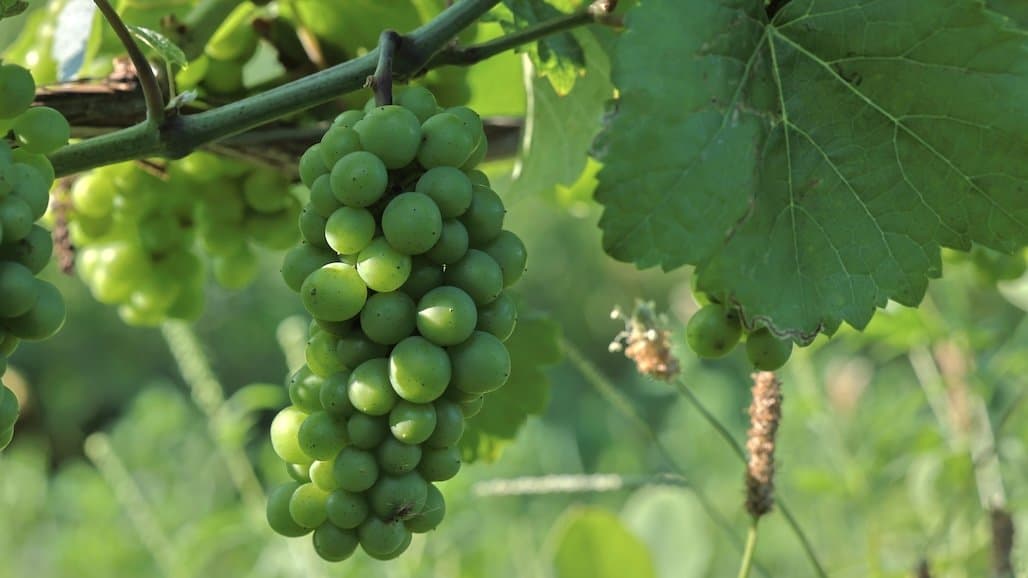
As of July 30th in southwest Michigan, most hybrids and juice grapes are at berry touch as are tight clustered vinifera cultivars. Leaf removal continues. The first round of cluster thinning is beginning. With concerns of harvest restrictions for juice grape growers, some Concord grapes are also being cluster thinned to improve quality at harvest.
In northern Michigan, grape clusters are currently progressing through modified E–L phenology stages 31–33. Berry size ranges from approximately 7 millimeters (peppercorn size) to 9 millimeters (pea size), indicating steady fruit development.
- Stage 32: Beginning of bunch closure; berries are starting to touch (in tighter clusters).
- Stage 33: Berries remain hard and green.
In the Tip of the Mitt AVA, hybrid cultivars are beginning bunch closure and beginning to soften. Vitis vinifera cultivars are approaching the berry touch stage. Japanese beetle activity is persistent. Black rot, downy mildew and powdery mildew have been noted in some vineyards. Risk for each remains moderate.


In southeast Michigan, veraison has been seen in Canadice grapes in Britton, Michigan, and first blush in Marquette grapes in Ray Township, Michigan. Grape berry moth trap counts remain low in Lenawee and Macomb counties. The risk of powdery mildew infection is high throughout the week of July 29–Aug. 4. Black rot and downy mildew risk remain low.
Advertisement


Horticulture
Accurate assessment of vineyard nutrient requirements is essential for optimizing vine health, fruit quality and yield. Implementing soil testing and petiole analysis provides critical data to inform nutrient management strategies. A quality soil test or a previous year’s petiole analysis is important in understanding which nutrients the vineyard needs.
Petiole analysis should be done at bloom and veraison, and at specific stages of vine development when nutrient concentrations in the petiole are most stable and representative of the vine’s overall status. The most widely recommended timing for petiole sampling is at full bloom, which occurs when approximately 70% of the flowers on a cluster are open. This stage provides the most reliable data for key nutrients such as nitrogen, phosphorus, potassium and micronutrients.
An alternative or complementary sampling period is at veraison, when about half of the berries on a cluster begin to change color or soften. Sampling at veraison can be useful for monitoring nutrients like potassium, magnesium and boron later in the season or for tracking changes in nutrient dynamics over time.
Early hedging for healthier canopies and better ripening in cool climates
Advertisement
Early hedging, or cutting shoots shortly after they reach just above the top wire, can improve canopy efficiency and fruit ripening in cool-climate vineyards like those in northwest Michigan. Research from Michigan State University (MSU) shows that early hedging preserves younger, highly photosynthetically active leaves and promotes lateral growth, which supports ripening during late summer. It also reduces fruit zone shading and disease pressure while directing vine energy toward fruit development.
Timing is critical. Too early can cause overly dense canopies, especially in vigorous cultivars. When done correctly, early hedging improves canopy balance, fruit quality and ripening consistency in regions with short growing seasons.
Cluster zone leaf removal: Timing and technique
To regulate grape quality in cool-climate regions, growers employ various canopy management practices to counter the challenges of a short growing season. One of the most impactful techniques is cluster zone leaf removal, which plays a key role in reducing disease pressure and enhancing fruit quality.
This practice improves spray coverage and airflow around the fruit, lowering humidity and minimizing the risk of harvest season cluster rot complex, including Botrytis and sour rot. Increased sunlight exposure also encourages development of a thicker wax cuticle on the berry skin, providing natural resistance to fungal infections and enhancing grape quality.
Leaf removal can be performed manually or mechanically, and the industry is rapidly transitioning toward mechanization to improve both efficiency and economic sustainability. The effectiveness of this practice depends heavily on timing, particularly in relation to grapevine phenology.
Leaf removal is typically applied between fruit set and veraison to improve cluster zone microclimate and increase disease resistance. When implemented around bloom or shortly before, it can also reduce fruit set and result in looser clusters, a valuable outcome for tight-clustered cultivars like Pinot noir and Riesling, which are prone to rot due to berry compression.
Advertisement
Early leaf removal, at pre-bloom or pea-size stage, offers additional benefits under climate change conditions:
- Promotes flavonol synthesis, protecting berries from UV damage.
- Reduces incidence of cluster rot, potentially lowering fungicide use.
Mechanical early leaf removal systems (Collard leaf remover) use compressed air to remove leaves and dead flower tissue from the fruit zone. Removing dead ovaries is critical, as they serve as an entry point and nutrient base for Botrytis spores. The pathogen can remain latent until berry sugar levels rise and acidity drops, after which rot symptoms develop rapidly in warm, humid conditions.
Read more in the MSU Extension article, “Cutting to the core: Michigan State research leads a canopy innovation in cool-climate viticulture.”
Diseases
In southwest Michigan, disease management of downy mildew, powdery mildew and botrytis fruit rot are the primary focus. The morning dews we will begin to experience are an important reminder to maintain protection against downy mildew. With tight clustered varieties, this is the last chance to get botrytis bunch rot sprays into the tight crevices of the clusters.
In northwest Michigan, disease pressure is still low but continues to increase in specific areas where black rot is becoming more apparent. Black rot symptoms are beginning to show up throughout the state (Photo 6), but it is largely too late to control these infections and fruits will begin to become resistant.
Advertisement
In this growing stage, consider choosing fungicides that control all the foliar and fruit diseases. For example, with downy mildew we are most concerned with foliar infection, and sprays should be timed regularly throughout the season when we experience heavy dews for optimal control. Downy mildew is caused by a fungal-like organism, so many site-specific systemic fungicides that target other spring diseases do not work on downy mildew. Effective fungicides for downy mildew include products in FRAC codes 4, 11, 21, 40 and 45 as well as phosphorus acid salts and some biologically-based products.

If powdery mildew is the only concern, there are a number of effective products (FRAC codes 3, 7, 11, 13, U8, 50, and U13 as well as sulfur). Combining fungicides from different FRAC classes should also be effective while helping with resistance management.

As we approach bunch closure in southwest Michigan, consider botrytis management. Several strategies contribute to good botrytis bunch rot management including opening up the canopy, properly applying fungicides, and using resistant cultivars when possible. Good botrytis control depends on getting good coverage. Just before bunch closure is the last chance to apply a fungicide to the inner part of the developing cluster. Fungicide resistance management is also important. The most effective products for botrytis are site specific and prone to resistance development. A Michigan Grape Fact Sheet is available for managing botrytis bunch rot.
As you choose a fungicide, check the guide for potential phytotoxicity of certain sprays on Concord grapes especially (this has been particularly noted for fungicides like Revus Top). Phytotoxicity risk is higher with high temperatures and quickly growing vines. Also, there is a significant phytotoxicity risk with specific contact products such as copper and sulfur for Labrusca type grapes (Concord and Niagara).
Insects
Advertisement
Southwest Michigan vineyards can expect grape berry moth third generation to begin between Aug. 2-5. The Enviroweather degree day model predicts Aug. 2 in Berrien Springs and Aug. 5 in Lawton. While the model is a useful guide, field observations can confirm timing. Last week, most larvae in clusters were large, with pupae seen on leaves—signs the second generation was ending. This supports the model’s prediction of third-generation activity starting in early August.
In most areas, there’s still time before harvest to use Intrepid or Intrepid Edge, which have a 30-day preharvest interval. Apply them at the predicted start of egglaying next week with thorough cluster coverage. Other broad-spectrum insecticides are better timed for egg hatch, expected about 100 degree days later—roughly four to five days at current temperatures. Depending on your cultivar’s stage, a treatment before bunch closure can help reach inside clusters, where coverage becomes harder later in August. However, the window for that timing is closing in most southwest Michigan vineyards.
At some treated sites this past week, we saw berries stuck together—one with clear larval damage, the other showing only minor feeding and no live larvae. This indicates an effective spray that stopped the larvae developing into the second berry. These post-spray assessments can be useful for seeing how your pest management program is working through summer so adjustments can be made.
As vineyards approach veraison, watch for signs of sour rot. This disease is caused by the combination of bacteria, fungi and vinegar flies, and is worst in sites with susceptible cultivars during warm late-summer conditions. We will have more information on sour rot and its management in next week’s report.— By Esmaeil Nasrollahiazar, Mike Reinke, Paolo Sabbatini, Rufus Isaacs, Logan Fairchild, Timothy Miles, Cheyenne Sloan, Derek Plotkowski, Karen Chou, and Vahid Rahjoo, Michigan State University Extension;