
Michigan State University released its latest grape scouting report, noting a faster rate of growth in the southwest portion of the state, while urging growers to continue monitoring for frost — particularly in the Tip of the Mitt region.
Southwest and Southeast Michigan
In locations not damaged by the spring frosts and freezes, juice grapes and early hybrid wine grapes are currently at approximately 3–6 inches of shoot growth in the southwest, with clusters separating and beginning to elongate. Hybrid and vinifera cultivars are generally between first leaf and about 1 inch of shoot growth.
In southeast Michigan, all cultivars are at the shoot elongation stage with inflorescence development. Wild grapes are also at the inflorescence elongation stage.
Northwest Michigan
Most Vitis vinifera cultivars have advanced beyond full dormancy and are currently pushing bud growth, with the first signs of green tissue visible. In some areas of the Leelanau Peninsula, early cultivars such as Cab Franc are now at bud break. Other cultivars remain in the bud swell stage, but development is expected to move quickly from this point forward if favorable weather continues.
Because development can vary considerably by location, cultivar, and microclimate, some vineyards may be slightly ahead of what was observed during scouting. Continue monitoring over the next several days as conditions change and vines continue to progress toward bud break.
Advertisement

Tip of the Mitt
In the Tip of the Mitt region, hybrid cultivars are at bud push. Vitis vinifera is beginning to push buds at the shoot apices. Closely monitor over the next several days as two cooler nights in the forecast may approach frost or freeze conditions.

For reference, see MSU Extension’s grape growth stages chart.
Viticulture
Early-season nutrient management should be guided by recent soil test results and prior-year petiole analyses. These tools provide essential information on nutrient availability and help inform fertilizer decisions as vines transition from dormancy to active growth.
Advertisement
In southern Michigan, where vines have reached early shoot development, nitrogen applications may begin using split applications to support growth while avoiding excessive vigor. Consider micronutrients such as zinc and boron to support early shoot and reproductive development. Monitor potassium and magnesium levels in vineyards with known deficiencies.
In northern regions, nitrogen applications should be delayed until active growth is established. This period is well suited for reviewing soil test results, finalizing fertility programs, and preparing for timely nutrient applications.
Nitrogen management remains critical across all regions. Excessive nitrogen can result in overly vigorous growth, delayed phenology and reduced fruit quality, while insufficient nitrogen may limit vine growth and yield potential. Balanced applications, guided by analytical data, are essential.
Canopy and crop management
In southern vineyards, shoot thinning is expected to begin within the next one to two weeks, depending on site and cultivar. Early canopy management decisions, including shoot thinning and initial crop load adjustments, should be based on vine vigor and uniformity. In northern regions, these practices will follow as vine development progresses and should be planned accordingly.
Soil health
Maintaining soil health remains an important component of vineyard management. Practices such as cover cropping, maintaining organic matter and minimizing soil compaction contribute to improved soil structure, water availability and nutrient uptake throughout the growing season.
Advertisement
For more detailed guidance on shoot thinning and early-season vineyard practices, please refer to the article “Early season vineyard management.”
Diseases
Bloom is the most critical period for fruit infection from black rot, powdery mildew and downy mildew. Scout carefully and protect open flowers with fungicides during this period.
Fungicide programs at bloom should prioritize materials with strong protectant and systemic activity, while rotating modes of action to manage resistance. Products in FRAC groups 3 (DMIs) and 11 (QoIs), often used in premixes, remain key options for powdery mildew and black rot, while multi-site protectants such as captan (M4) or mancozeb (M3) provide additional coverage and help reduce resistance risk.
For downy mildew, materials in FRAC groups 40, 45, 21 and 11, as well as phosphorous acid products, are effective choices when conditions favor infection. Careful selection and rotation of these chemistries, combined with thorough coverage during bloom, are essential to protect developing clusters and limit early-season disease establishment.
Insect pests
Grape berry moth traps indicated high activity of male moths across southern Michigan in the recent warmer weather. This first period of activity is not associated with egglaying by females, but we will continue to monitor a few sites to check on young clusters.
Advertisement
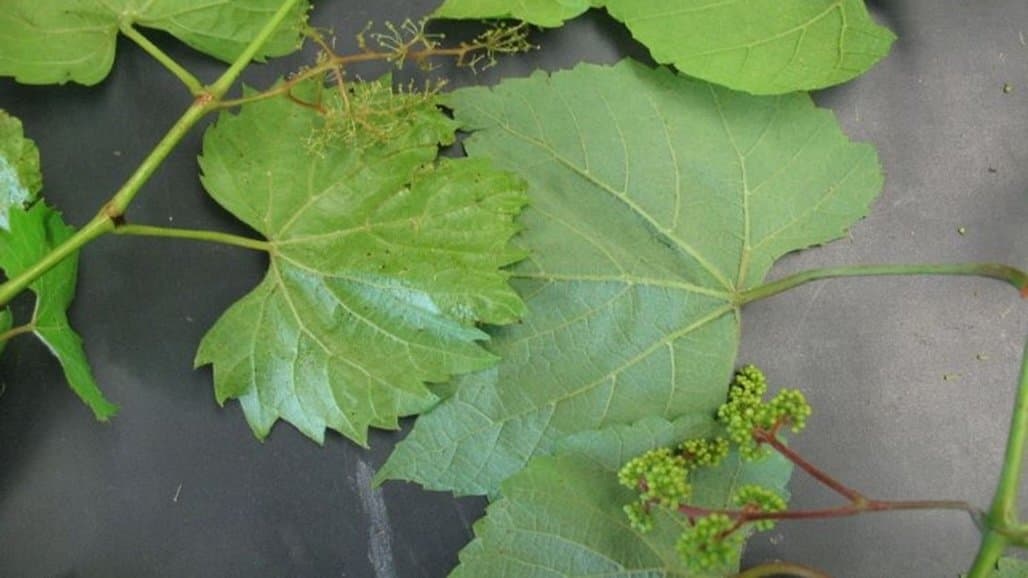
The next step for grape berry moth integrated pest management is to identify the timing of wild grape bloom. Track this and record the date for your vineyard site(s) so you have that later for the grape berry moth model timings in July and August. The date to record is when 50% of the flowers are open on 50% of wild grape clusters. Make sure you have the correct wild grape species. This is Vitis riparia, which has glossy undersides to the leaves and blooms before Concord. The other common wild grape, Vitis aestivalis, should not be used because it blooms after Concord with short, whitish-gray hairs on the leaf underside and red tendrils.
As new leaves expand, “window-pane” damage is visible on leaves where flea beetle activity was observed last month. Vines can withstand this leaf damage and it rarely reaches economic injury levels.
Grape tumid gallmaker symptoms were observed on hybrid grapes this week. This can be isolated to a few vines where infested leaves and clusters can be removed and destroyed. Widespread infestation may require treatment to protect leaves and clusters. Assail is one effective option that can protect from further infestation.

Weeds
Early-season weed management is important in vineyards to reduce competition for water, nutrients and light, especially in young or newly planted blocks. Maintaining a relatively clean undervine strip during early shoot growth can support vine establishment, improve nutrient uptake and reduce competition during a critical period of vine development.
Scout vineyard floors now to identify winter annuals, emerged summer annuals and perennial weeds. Winter annual weeds may already be flowering or setting seed, so timely control can help reduce seedbank inputs. Summer annual weeds such as pigweed, lambsquarters, foxtails and annual grasses will continue emerging as soils warm.
Advertisement
Several herbicide options are listed in the 2026 Michigan Fruit Management Guide. In established vineyards, the first step is to determine whether weeds have already emerged.
If the vineyard floor is clean, a residual herbicide such as Chateau, Prowl H2O, Surflan, Princep, Karmex, Zeus XC, Zeus Prime XC or Alion may be used, depending on vine age, soil type and label restrictions.
If weeds are already present, include a labeled burndown herbicide such as glufosinate, paraquat, glyphosate, Aim or Venue with the residual product. Examples include glufosinate + Chateau, glyphosate + Prowl H2O, glufosinate + Zeus XC or Zeus Prime XC, glyphosate + Princep, or Karmex + Prowl H2O or Surflan, where labeled and appropriate. Apply Zeus XC and Zeus Prime XC to weed-free soil or with a burndown partner if weeds are present. They should not be tank-mixed with Chateau.
For grass-only problems, Fusilade DX, Poast or Assure II may be used when grasses are actively growing. Organic growers may consider caprylic plus capric acid products where labeled.
Apply all postemergence herbicides as directed sprays to the vineyard floor and avoid contact with green shoots, leaves, green bark, suckers, and young vines. Always follow the label for crop age restrictions, rates, adjuvants, preharvest intervals, and tank-mix compatibility. Rotate herbicide sites of action and integrate mowing, cultivation, cover crops, or other nonchemical tactics to reduce herbicide-resistance risk.
Read the full grape report here.
— Story contributed by Michigan State University