
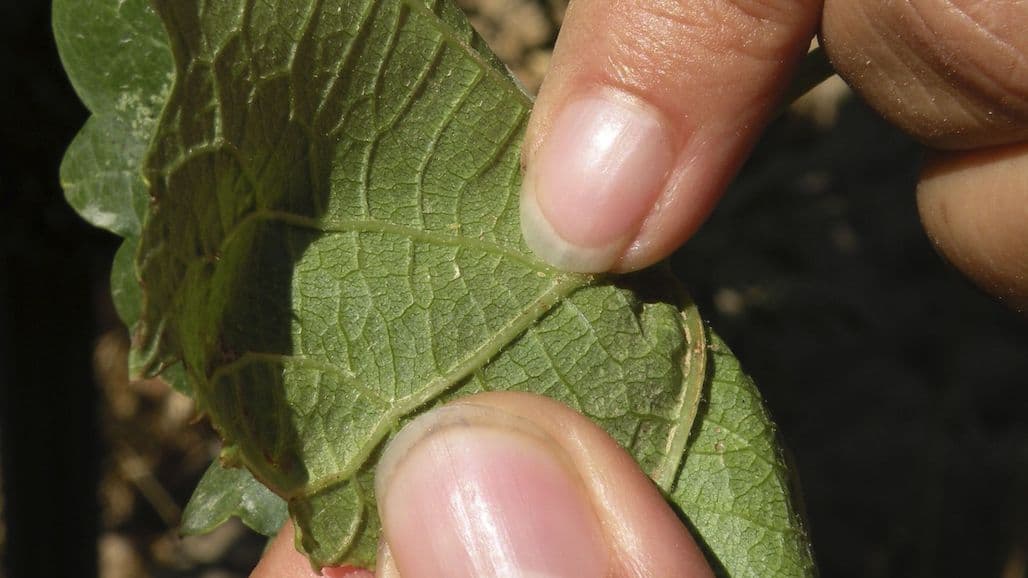
 Recent studies have demonstrated that the viruses that cause Grape Leafroll Disease (GLD) are widely prevalent in mid–Missouri vineyards. While it is not clear if GLD will significantly impact the American and hybrid grape varieties grown in Missouri like it has European varieties, steps should still be taken to limit the spread of these viruses between infected and uninfected grapevines. These viruses can spread to uninfected grapevines by grafting and by various “soft scale” insects. While several species of scale insects can spread the viruses that cause GLD, the grape mealybug, Pseudococcus maritimus, is the most common in the Midwest.
Female mealybugs, if present, are in vineyards year–round, however they are only active from early spring through late summer; during the winter months they are “hibernating” underneath the bark down near the trunk of grapevines. During the growing season, female mealybugs crawl (they don’t fly) around grapevines and feed on plant material using a sharp, straw-like mouthpart to suck up precious sugar from the vines. In the process, these female mealybugs can pick up GLD–causing viruses and spread them to other vines during subsequent feedings. Male mealybugs are capable of flying, do not feed, and only live for about 3 days (they emerge to mate, then die). Because grape mealybugs have two generations each season, there are two distinct periods during which male mealybugs can be found flying around vineyards looking for females to mate with. These periods represent opportune times to detect the presence of the mealybugs and to interfere with the mealybug life cycle.
In April 2021 a monitoring program was conducted in mid–Missouri that utilized sex pheromone–baited traps to monitor grape mealybugs in vineyards. These traps emit a unique chemical that attracts male grape mealybugs from very far distances. Traps were deployed in 14 vineyards across mid–Missouri, from Kansas City to the Mississippi River, and checked every two weeks through August. The results from this survey revealed two important findings: first, that grape mealybugs were present in all 14 survey sites (Figure 1) to varying degrees; and second, that the reproductive male flights peaked during the end of May and mid–August, in 2021 (Figure 2).
The trapping data collected during the 2021 field season provides insight into male mealybug reproductive flights in mid–Missouri, indicating the short periods during the season where they (and adult females) are relatively exposed and therefore more vulnerable to chemical and biological control tactics. Control tactic application will likely be more efficient and effective if they are aligned with these periods of vulnerability.
In addition to monitoring grape mealybug populations and reproductive cycles in the 2021 survey, 56 field–collected specimens were tested using molecular techniques to verify species pre- sent and to test for GLD–causing viruses present in the mealybugs. All 56 field-collected mealybugs were verified to be the grape mealybug, Pseudococcus maritimus, and 10 were found to contain GLRaV–3, the main causal agent of GLD. Taken together, these data indicate that grape mealybugs are relatively widespread in mid–Missouri vineyards and that they are sucking up GLD–causing viruses from the grapevines they feed on. Because it is well–documented that grape mealybugs are capable of transmitting these viruses to uninfected grapevines, vineyard managers seeking to maintain GLD–free grapevines should develop grape mealybug control measures to prevent the spread of GLRaV–3.
The mid–Missouri mealybug monitoring program will continue during the 2022 and 2023 growing seasons. Vineyards interested in participating should contact Jacob Corcoran by email (Jacob.corcoran@usda.gov) to express their interest. This program is free to participants as it is funded by the MU Grape and Wine Institute.
— By Dr. Jacob Corcoran, USDA – Agricultural Research Service