
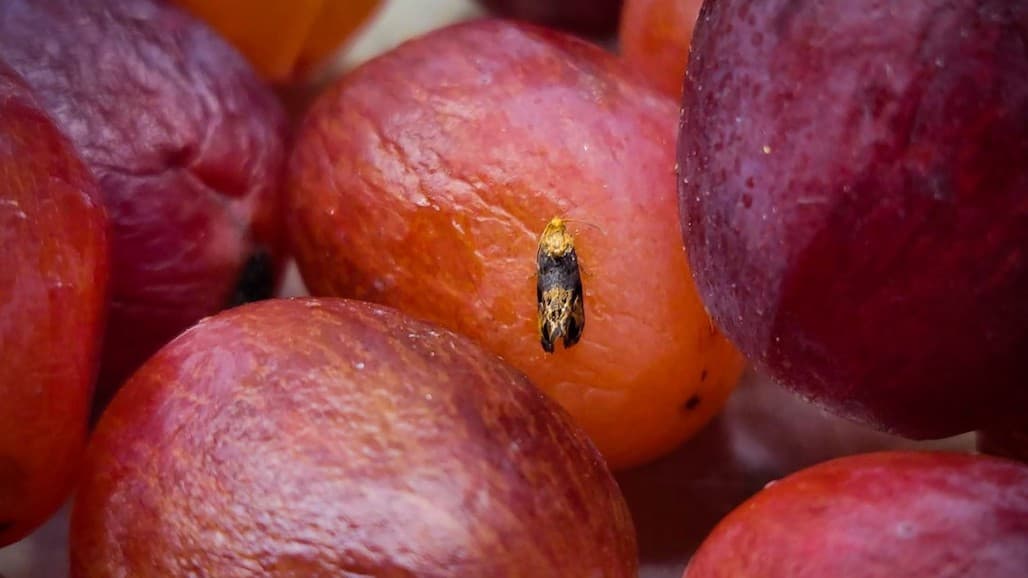
Grape berry moth (GBM) is a native North American pest that can reduce fruit quality both directly and indirectly. The immature or larval stage of the pest tunnels into fruit reducing fruit quality. The entry holes (“stings”) of the larve compromise the integrity of the berries and provide an entry point for assorted fruit rots including sour rot (Figure 1). There are 3 generations of GBM. The first generation of GBM appears around 400 cumulative degree days at a base temperature of 47° F. The appearance of the first generation coincides with the bloom of wild grapes. Vineyards that have had consistent year to year problems managing GBM should manage this first generation. Since the emergence of the first generation of GBM coincides with wild grape bloom most of the GBM at this time will be in vineyard perimeters especially near wooded areas. Consider using a number of methods to monitor for the appearance of first generation GBM. Monitor wild grapes for bloom, calculate the number of growing degree days that have accumulated since April 1 at a base temperature of 47° F and monitor the appearance of GBM using pheromone traps.
Get historical weather information from Missouri Mesonet weather stations Select a weather station that is nearest your vineyard. Select average temperature for the period from April 1, 2022 to present day. Download the information into an excel spreadsheet and subtract 47 from the average temperature for each day (Figure 2). Remember to correct the data that provides negative numbers to zero. Sum the degree days which is the cumulative degree days that have accumulated since April 1.
Before trying to manage the second or third generations of GBM, you need monitor temperatures, and also understand a bit about the biology of GBM. Rufus Isaacs at Michigan State University (MSU) has shown that GBM takes 810 and 1620 GDD after wild grapes (Vitis riparia) bloom for the second and third generations, respectively to start egg laying. The biofix in this MSU model is the date in which wild grapes are flowering. Flowering is defined when 50% of the inflorescences have 50% of their flowers open. Typically wild grape blooms 8 to 14 days before most of the commercial grape cultivars bloom. Over the years a number of GBM models have been developed that use different biofix dates. For example, male GBM trap captures and degree day accumulations since April 1 and January 1 are common. However, a biofix date based on grape phenology seems to be working more effectively.
Managing GBM
The first generation of grape berry moth typically appears in the vineyard at bloom. If your vineyard has been experiencing severe GBM damage consider applying an insecticide 10–days post bloom for control. The first generation of GBM is often more of a problem on the perimeter rows in the vineyard. Focus cover sprays on these perimeter rows especially perimeter rows that are along wooded areas.
Second and third generation GBM can be managed by timing insecticide sprays based on the degree day model. Since the model predicts the egg laying of GBM, you have to consider your insecticide options. Altacor and Intrepid should be applied at 810 and 1620 GDD after bloom of wild grape. These insecticides need to be applied at the egg hatch or newly hatched larval stage of GBM. Both of these insecticides are considered reduced risk pesticides. Intrepid will only control Lepidopterous larvae and therefore will preserve natural enemies. Both Altacor and Intrepid have long residual control of GBM. If using broad–spectrum insecticides (Sevin XLR, Brigade or others), the insecticide should be applied at 910 and 1720 GDD after wild grape bloom. The latter applications of these broad–spectrum insecticides are targeting larva at various stages in their development.
Scouting and Monitoring for GBM
Pheromone traps should be placed in the vineyards in early April. There are a number of suppliers. Traps should be placed within the grape canopy. When placing traps make sure that adult moths have a direct path into the trap (Figure 1). Remove grape leaves or trim shoots that obstruct entry into the trap. It is also important to monitor developing grape clusters for GBM damage. A telltale sign of a GBM damage are “stings” (Figure 2) White webbing with two or more berries webbed together (Figure 3). This webbing often has small specs of early instar GBM frass. On red berried cultivars another telltale sign of GBM is early coloration of the berries well before the onset of veraison. In addition, the first generation pupae of GBM will often be found on leaves in which the leaf edges have been rolled under by the larvae before pupation. — By Dean Volenberg, University of Missouri Grape & Wine Institute

Article By
Dean S. Volenberg
Viticulture Program Leader, University of Missouri Grape and Wine Institute
Dean Volenberg is Viticulture Program Leader and an Extension Assistant Professor in the Division of Plant Science and Technology at the University of Missouri, where he works with the Grape and Wine Institute. His applied research examines how canopy management, vine balance and integrated pest management affect grape quality, and he provides viticulture and winery extension throughout Missouri. He holds a Ph.D. in agronomy and an M.S. in horticulture from the University of Wisconsin.