
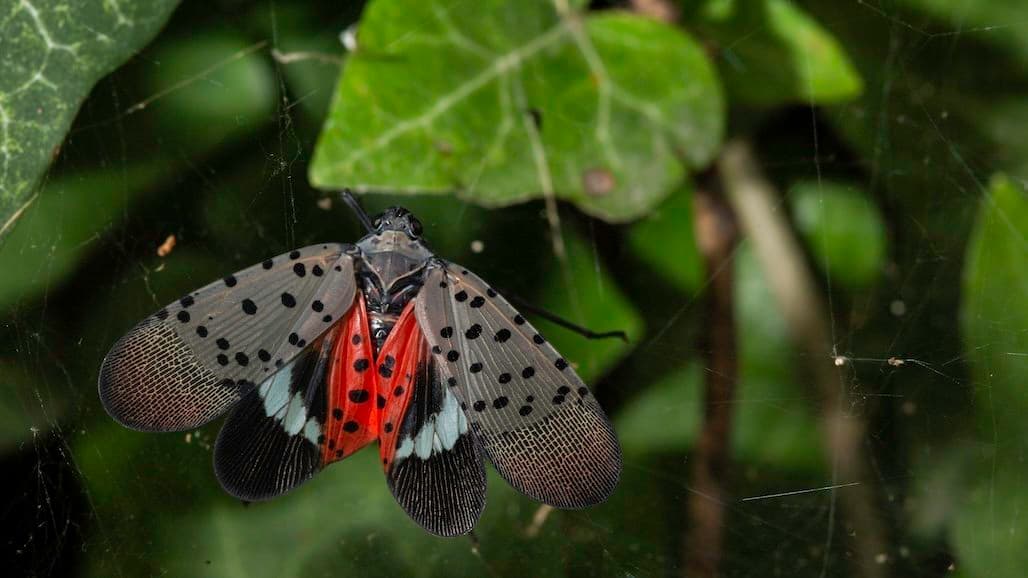
Local vineyards, including the Long Island Horticultural Research & Extension Center (LIHREC) hybrid block, reported low-to-moderate numbers of winged spotted lanternfly (SLF) adults in 2025. In the LIHREC vineyard, from mid-August through October, the vineyard was not inundated but we had no trouble finding a few here and there daily. Unfortunately, many vineyard owners who saw adults last season found egg cases this past winter. In the LIHREC vineyard, these were most commonly on the anchor side of end posts and on the underside of cordons.
Many in the industry were worried about the springtime hatch of SLF nymphs. According to CCE Entomologist Dan Gilrein, SLF hatch can be estimated at https://newa.cornell.edu/spotted-lanternfly. Further, Dan states that ‘Erica Smyers did her grad work on SLF in Pennsylvania and Virginia and found that 5% of eggs hatched at 164 (PA) to 173 (VA) degree-days (base 50.7 °F) with calendar dates from May 1 to May 3. More generally, some use 200 DD as the approximate threshold for emergence’. There were 184 GDD in Riverhead as of May 4.
The 1st-3rd instars of SLF are active May through July. These stages are black with white spots and no wings. The 1st instar is small enough that it is sometimes mistaken for a tick. Nymphs feed on sap from a wide range of plants, including both herbaceous plants and the tender growth of woody plants. Adults have a narrower host range, feeding primarily on woody plants such as grapevine, tree of heaven and black walnut.

Photo caption: Last winter, many growers found spotted lanternfly egg masses like these on the anchor-side of endpoints or the underside of cordons. These egg masses were found on a vineyard in New Jersey. Photo by Nancy Power
From the Penn State website: “Nymphs are in near constant motion when they are not feeding. They climb any trees that they encounter and then launch or “fall” from the crowns and move to the next plant. They often move in groups from one plant species to another and may only remain on the same plant for a day or two. Group aggregation increases with each life stage. Nymphs ingest less volume of tree sap than the adults, so a population of nymphs is thought to be less damaging than the same number of adults would be.”
There are several factors that dictate the need for insecticide to control nymphs. Nymphs are highly mobile, have a much wider host range versus. adults and ingest much smaller amounts of sap. Consequently, it is unclear whether control of nymphs has any bearing on subsequent infestations by the more damaging adult stage. If a nymph infestation is unusually heavy, consider a targeted treatment on a hotspot. Alternatively, treatments applied for control of pests such as grape berry moth may provide some incidental control of nymphs. Of the pyrethroid group, Mustang Maxx will cause less damage to biocontrol agents and may be less expensive than other options.
Advertisement
The list of NY-approved insecticides, both conventional and organic, may be found within the Cornell SLF site. Be sure to check out the ag section, not the home gardener list.
— By Alice Wise, Cornell Cooperative Extension, Suffolk County