
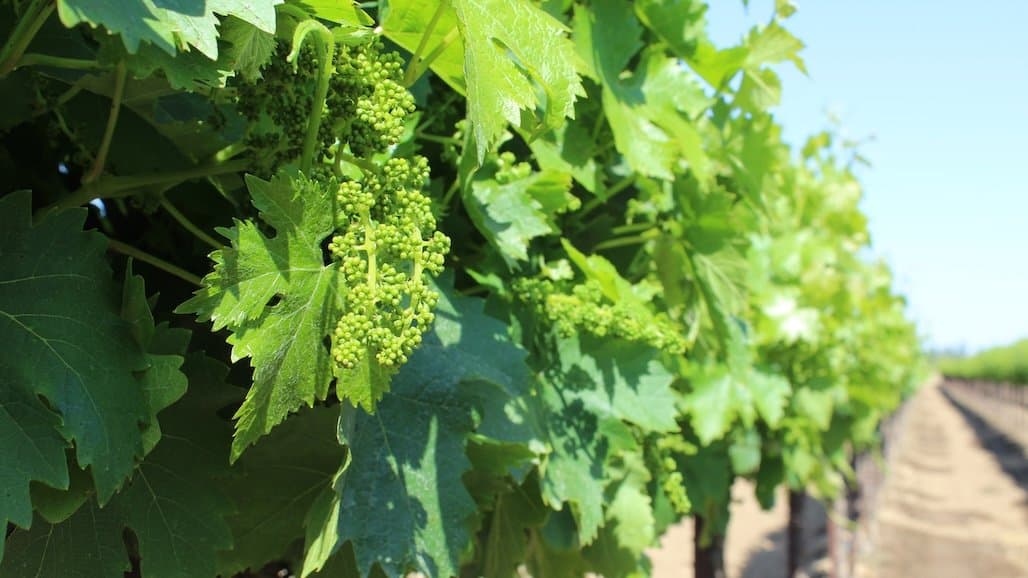
There are three major stages in the growth and development of grape berries that require attention to detail for crop protection. The period from immediate pre-bloom through 5 to 6 weeks post bloom is the most critical time to protect your crop from pathogens. This period is when your grape crop is the most susceptible to fungal pathogens.
As the phenology of the vines progress from vegetative growth to reproductive growth the potential for disease increases. Prior to pre-bloom disease management focused on keeping the shoots, leaves and developing inflorescences protected from disease. Depending on your vineyard location the inflorescence will soon begin flowering and this calls for increased vigilance to protect the crop from pathogens.

Right now we are entering the period where attention to detail will pay dividends at harvest. The immediate pre-bloom to 5 to 6 weeks post-bloom is when you should consider using your best disease management tools to control the grape disease complex.
Select fungicide products that will provide protection from phomopsis, black rot, downy mildew, powdery mildew, and anthracnose. These are the five major diseases of concern. Take some time now to plan for your next three cover sprays. This will help to avoid applying the same products repeatedly which can result in the selection for fungicide resistant pathogens. Depending on your past disease problems from last season as well as disease outbreaks that may have occurred this season consider using both systemic fungicides as well as protectant fungicides in a tank mix to protect your crop.
Phomopsis remains a threat, especially during the bloom period. During bloom Phomopsis spores can infect developing flowers. Phomopsis development remains dormant in developing berries until brix levels begin to rise starting at approximately 15 brix. Infected berries begin the rotting process and some infected berries shatter. The primary inoculum of Phomopsis declines as temperatures begin to rise Although grape berries are susceptible to Phomopsis throughout the growing season, reduced primary inoculum coupled with increasing temperature conditions reduce the threat of Phomopsis infections after the bloom period. Also keep alert for Downy mildew, Black rot, and anthracnose infections. Extended wet periods during the critical period of immediate pre-bloom to post bloom are ideal conditions for infection by the diseases listed above. Consider applying a systemic fungicide tank mixed with a protectant fungicide to extend your spray cover window during extended wet periods.
Use The Best Fungicides To Protect The Crop: Avoid Repeat Applications Of The Same Fungicide And Fungicides From The Same Chemical Class
Advertisement
During the critical period (pre-bloom to 5 to 6 weeks post bloom) fungicides from two chemical classes are often applied. Fungicides from these two classes provide good protection to a broad spectrum of pathogens. The two classes of fungicides are the Qol fungicides=strobilurins (FRAC 11) and the DMI fungicides=sterol biosynthesis inhibitors (FRAC 3). Powdery mildew in Virginia, Michigan, Georgia, Missouri, and Oregon have been identified that are resistant to strobilurins or DMI fungicides. Downy mildew in Virginia and North Carolina has been identified that are resistant strobilurin fungicides. Therefore when planning your critical period spray program implement a spray program that avoids sequential applications of the same product or products within the same FRAC cade. Many of the labels of both strobilurins (Frac 11: Abound, Sovran, Flint) and sterol-inhibitors (Frac 3: Mettle, Procure, Rally or Tebuzol) limits the number of applications during the growing season. For example, the Rally label states that only 2 sequential applications of Rally or Rally and another product containing the same active ingredient as Rally or another Sterol inhibitor can be applied. Fungicides that contain more than one active ingredient (Pristine, Inspire Super, Revus Top, or Quadris Top) are also effective for broad spectrum disease management.
As the grape berries age they become resistant to some fungal diseases. Grape berries develop resistance to Black rot, downy mildew and powdery mildew approximately 3 to 6 weeks after bloom. Therefore early season disease management through post-bloom disease management are critical. Although berries develop resistance other green tissue remains susceptible throughout the growing season.

In Summary
• Timing is critical for fungicide applications, be sure you know how to identify the immediate pre-bloom stage (Figure 2).
• Keep spray intervals at 7 to 10 days starting from immediate pre-bloom through post-bloom.
• Ensure thorough spray coverage. If rain is forecast and your last spray was applied 7 to 10 days ago, then spray prior to the forecast rain event.
Advertisement
Grape Stage and Application Timing is Critical for Successful Disease Management
• Immediate Pre-Bloom: When the florets of the inflorescence separate from apart from each other (Figure 2).
• Bloom: When 50% of the inflorescences have 50% of the flowers open (length of bloom is often 5-to7-days but can be longer if cool temperatures prevail during bloom).
• Post Bloom: When the fruit begins to set. Grape berries are very susceptible to infection by diseases until 5 to 6 weeks post bloom. — By Dean Volenberg, University of Missouri Grape & Wine Institute

Article By
Dean S. Volenberg
Viticulture Program Leader, University of Missouri Grape and Wine Institute
Dean Volenberg is Viticulture Program Leader and an Extension Assistant Professor in the Division of Plant Science and Technology at the University of Missouri, where he works with the Grape and Wine Institute. His applied research examines how canopy management, vine balance and integrated pest management affect grape quality, and he provides viticulture and winery extension throughout Missouri. He holds a Ph.D. in agronomy and an M.S. in horticulture from the University of Wisconsin.