
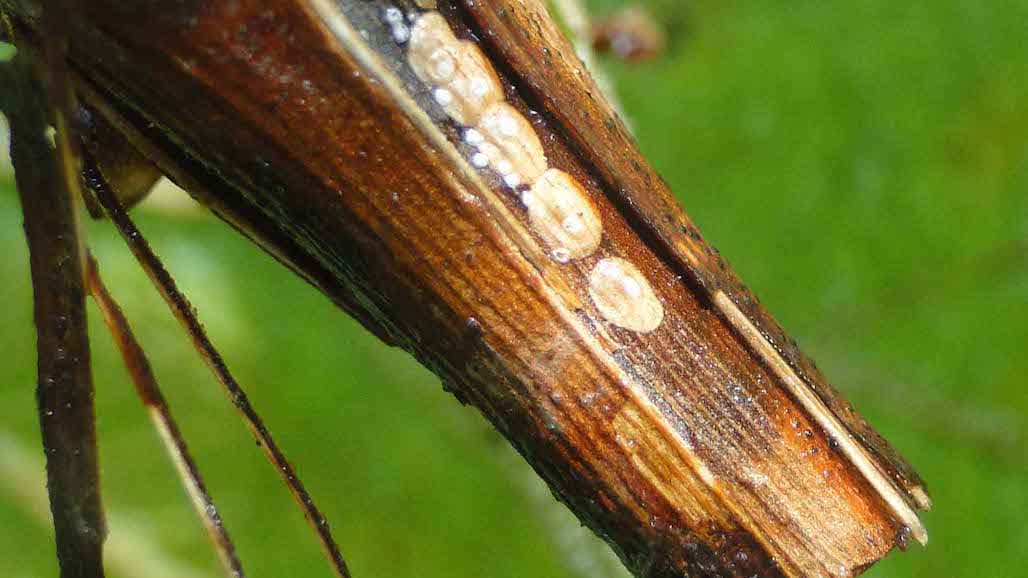
These two insects share a lot in common. Both can be found on grapevines but seldom are they readily apparent to the naked eye. First the bark needs to be peeled away from the trunk or cordon to reveal the insects (Figure 2). If these insects are apparent, the insects you are seeing are female. These females have piercing sucking mouthparts and feed on the grapevines plant sap. The males of both these insects are winged and look completely different compared to the females which is called sexual dimorphism.
Both of these insects need different management strategies. The grape mealybug is managed by monitoring the male flights using pheromone traps. There are two periods during the growing season when males are in flight searching out unfertilized female mealybugs. These two time periods represent two generations per growing season. During these two flight periods mating can be disrupted by applying an insecticide (Table 1). For more information on the male flight timing see the link at the end of the article.
To manage the grape scale there are various management strategies. First be aware that scale insects have a large contingent of other insects that attack and kill them. It is important to preserve these natural enemies by selecting pesticides that are not broad spectrum. Superior oil can be applied prior to bud break to the trunks and cordons. The application of Superior oil needs to saturate the trunks and cordons. Superior oil is efficacious by reducing oxygen uptake and disrupting the cellular membranes of the scales. Superior oil preserves the natural enemies.
The next strategy for controlling the grape scale is to apply an insecticide when the first instar or crawler stage is present. The first generation crawler or spring generation begins to emerge at 274 degree days (DD) (base 50 F) with peak crawler emergence at 356 DD (base 50 F) with DD being accumulated from April 1. The second generation crawler or Summer generation begins to emerge at 1166 DD (base 50 F) with peak crawler emergence at 1541 DD (base 50 F) with DD being accumulated from April 1. Besides monitoring degree days, apply double sided tape around trunks of grapevines that have known grape scale to monitor for crawlers.
Insecticides for controlling grape scale crawlers
The following insecticides, Applaud 70DF, Carbaryl (Sevin XLR), Movento 2SC, Admire Pro, and Assail 30 SG should control grape scale crawlers but the label does not specifically list grape scale. Additionally the pyrethroids (Baythroid, Mustang Max, Danitol and others) should control grape scale crawlers. Knack is an insect growth regulator that suppresses embryogenesis of insect eggs and has no activity on adult insects.
Application timing that targets the crawler stage of the grape scale is critical. — By Dean Volenberg, University of Missouri Grape & Wine Institute
Advertisement


Article By
Dean S. Volenberg
Viticulture Program Leader, University of Missouri Grape and Wine Institute
Dean Volenberg is Viticulture Program Leader and an Extension Assistant Professor in the Division of Plant Science and Technology at the University of Missouri, where he works with the Grape and Wine Institute. His applied research examines how canopy management, vine balance and integrated pest management affect grape quality, and he provides viticulture and winery extension throughout Missouri. He holds a Ph.D. in agronomy and an M.S. in horticulture from the University of Wisconsin.