
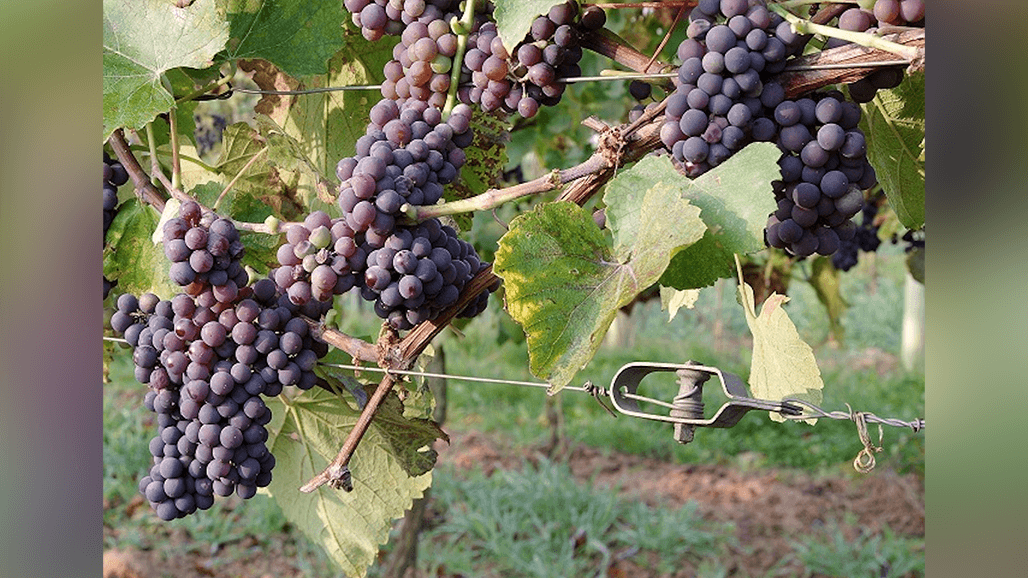
A recent main focus of my research program is to identify grape cultivars that may have potential success for the Missouri grape and wine industry. Besides evaluating readily available named cultivars and advanced grape breeder selections, I search out for named cultivars that were lost during prohibition. These cultivars were sent across the Atlantic ocean to serve as rootstocks for the European wine industry that was succumbing to root Phylloxera. Fortunately some of these cultivars still exist in France although the wine made from them is forbidden, but that is another story. Many of these lost cultivars have made there way to other countries and complicating the process have taken on new names.
Recently, the cultivar Cunningham was delivered to Foundation Plant Services in Davis California from Portugal . Historically, the Cunningham grape was from the garden of Jacob Cunningham in Prince Edward County, VA. Cunningham in part has a genetic background of Vitis aestivalis var. bourquiniana. Cunningham is late maturing grape and is used to make still wine and madeira style wines. I am hopeful that Cunningham grapevine with its V. aestivalis genetic background will have a broad tolerance to common fungal pathogens, similar to Norton.
 A major focus is to identify sustainable grape cultivars for the grape industry. Grape cultivars derived from the species aestivalis are natural fit to a sustainable grape industry. Just look at the past and current success of Norton and Cynthiana. Both Norton and Cynthiana have a broad tolerance/resistance to many common fungal pathogens.
The success of the grape industry is strategic initiative driven by the recent objective of the Grape and Wine Institutes strategic plan.
Objective E&I.2. Conduct Research to Improve Cultivars and Best Practices.
Through applied research, develop and/or identify cultivars and best practices that will produce high quality grapes that (a) are adapted to environmental change, (b) are sustainable, and (c) have potential for making wines that meet consumers’ taste preferences.
The success of this project is driven by all of us in the grape and wine industry. I call on you to bring new cultivars that may have been lost historically to my attention. You may find these lost cultivars in your readings or in your travels. Some lost American cultivars remain hidden away in far reaches of the world, simply under a new name. As an example, in Madeira, Portugal, the Cunningham grape goes by the name Canim. — By Dean S. Volenberg, Viticulture Extension Leader, University of Missouri Grape & Wine Institute

Article By
Dean S. Volenberg
Viticulture Program Leader, University of Missouri Grape and Wine Institute
Dean Volenberg is Viticulture Program Leader and an Extension Assistant Professor in the Division of Plant Science and Technology at the University of Missouri, where he works with the Grape and Wine Institute. His applied research examines how canopy management, vine balance and integrated pest management affect grape quality, and he provides viticulture and winery extension throughout Missouri. He holds a Ph.D. in agronomy and an M.S. in horticulture from the University of Wisconsin.