
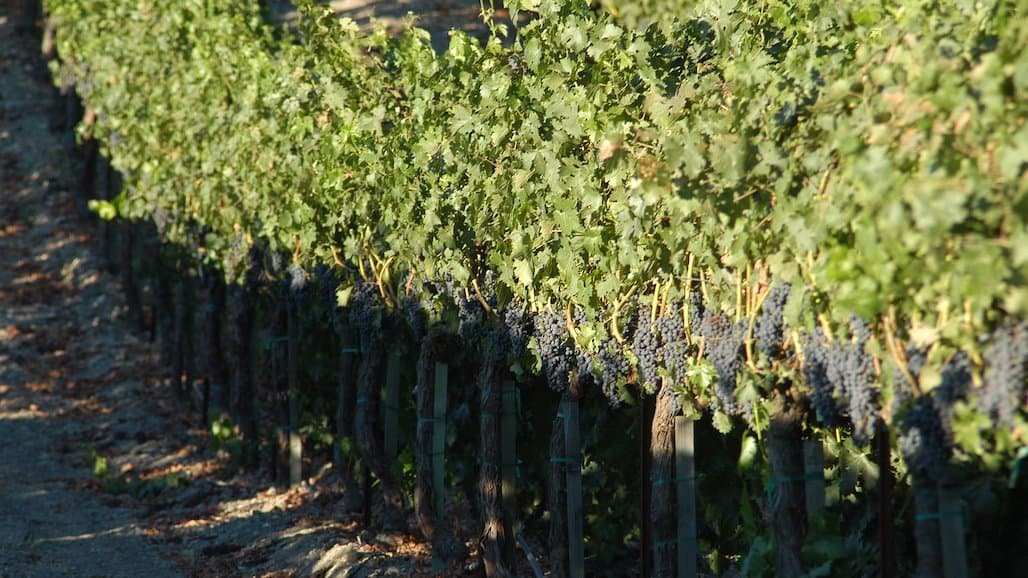
The age-old question is do drought stressed grapevines make better wine? The answer. Grapes produced in a “dry” growing season often make wine of high quality. However, water stressed or drought stressed grapevines perform best when yield and grape quality is balanced. In other words, grapevines need adequate water to be productive and healthy.
Water stress is but one form of stress and other biotic and abiotic stresses can come in many forms such as grapevine trunk diseases, foliar diseases and internal insect pests-grape root borer. These stresses further decrease water flow in the grapevine and exacerbate water stress. When drought stress is combined with other stresses It is important that you understand how all these stresses impact the vine and do not jump to the conclusion that the grapevines are simply under water stress from drought conditions. Investigate all the factors that may be impacting the grapevine including the water holding capacity of the soil.
Different soil types hold various amounts of water. Clay and silty loam soils hold the most water at approximately 6-acre inches of water in 24-inches of soil. In comparison, sandy soils have only approximately 0.7-acre inches in 24 inches of soil. An acre inch is approximately 27, 200 gallons of water.
Grapevines use water in the soil to grow. The amount of soil water that evaporates from the soil surface and from plant leaves via transpiration that is lost to the atmos- phere is termed evapotranspiration (ET).
For grapevines typically ET is calculated using the Penman-Monteith equation which uses evaporation from an open pan and also from grass and is labelled ETo. As you can imagine ET changes during the seasonal growth and development of the grapevine. In Missouri, evapotranspiration for the period May 21 to June 20, 2023 ranges from 4.01 to 6.0-inches. This 30-day period equates to a daily average ET of 0.2- inches/day.
Grapevines display water stress symptomology within different parts of the canopy. To visually assess grapevines for water stress, focus on the shoot tips, tendrils, leaves, clusters and the overall grapevine canopy. Grapevines under water stress display symptoms as shown in Table 1.
In commercial grape growing regions soil moisture stress is often quantified with a pressure chamber. In short, the pressure chamber applies air pressure to a leaf blade until a water droplet is just visible on the excised petiole to the naked eye. Water within a plant is pulled through the xylem by the evaporation of water from the leaves. Water within the xylem is under tension and as the soil becomes dry this creates more tension to pull water upwards to the leaves. This water tension is measured in negative bars and specific values indicate water stress for specific plants. If you want to learn more about pressure chambers please see here – Pressure Chamber
Advertisement
Newly planted or establishing grapevines
For vineyards established this spring water stress from drought should be avoided by irrigating as needed. In addition, weed management must be maintained during drought stress. Young grapevines (2-5 years old) experiencing severe drought stress and of fruit bearing age also should be irrigated. If grapevines are experiencing severe drought stress and irrigation can not be applied then the crop should be removed. Severe drought stress reduces bud fruitfulness for next year’s crop and also imperils cold hardiness during the grapevines dormant period.
In summary, water stress caused by drought can negatively impact grapevines. Next years count-buds (fruiting buds) development is hampered by drought stress. The count-buds also fail to acclimate to cold temperatures when drought stressed. Keep a close eye on vineyard blocks for signs and symptoms of drought stress (Table 1). Keep newly planted vineyard blocks adequately watered to aid grapevine establishment.
 Esca, Apoplexy and Drought
Some grapevine diseases are difficult to diagnose. A symptom that I have often observed in my days within vineyards during drought periods is apoplexy (Figure 1). A vine appears healthy one day and the very next day it appears wilted. When this is first observed there is a tendency to look at the leaves for symptoms of disease. This innate human behavior has me looking for something, anything but there just were no leaf symptoms. For many years I wondered why the leaves were void of symptomology.
The next step has been to start dissecting the vine knowing that the grapevine
trunk disease Esca was likely the causal organism. Confounding the situation is that I have walked in many vineyards when drought was not a factor and observed the typical symptoms of Esca on leaves. Esca causes chlorotic and necrotic necrosis between the main leaf veins that is often referred to as tiger stripping (Figure 2).
GTD, Esca and drought
 A fairly new research publication, provides new information on the interaction of Esca and drought. The research compared Cabernet sauvignon grapevine on 101-14 rootstocks that were under drought stress versus adequately watered. Drought stressed grapevines did not develop the classic tiger-stripe leaf symptoms compared to the adequately watered grapevines. The research was done by removing Esca infected grapevines from a vineyard and repotting them and growing the grapevines within a glasshouse. The experiment was repeated. The research was performed in Bordeaux France. Full paper here — By Dean Volenberg, University of Missouri Grape & Wine Institute

Article By
Dean S. Volenberg
Viticulture Program Leader, University of Missouri Grape and Wine Institute
Dean Volenberg is Viticulture Program Leader and an Extension Assistant Professor in the Division of Plant Science and Technology at the University of Missouri, where he works with the Grape and Wine Institute. His applied research examines how canopy management, vine balance and integrated pest management affect grape quality, and he provides viticulture and winery extension throughout Missouri. He holds a Ph.D. in agronomy and an M.S. in horticulture from the University of Wisconsin.