
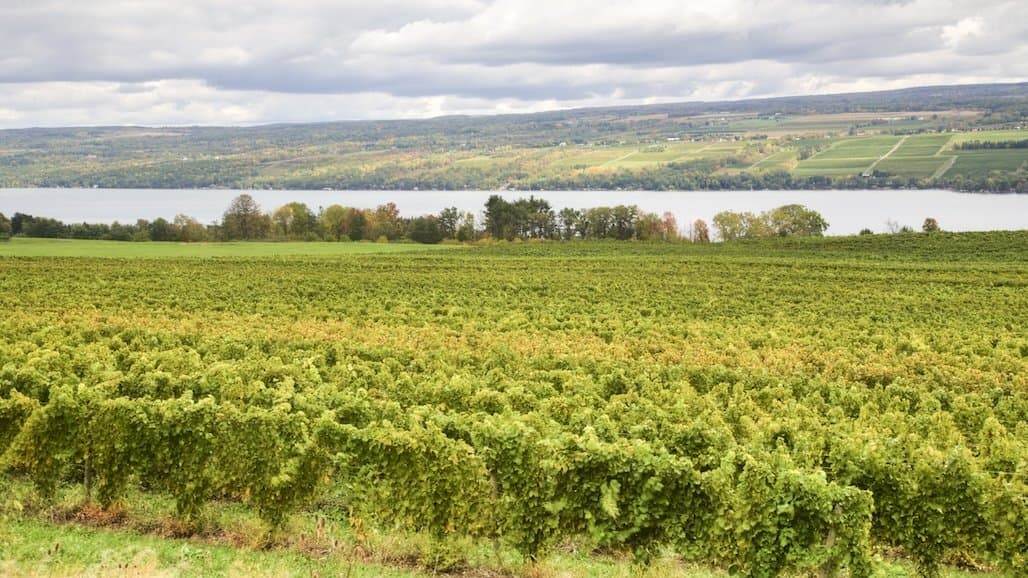
All the hybrid grape varieties on Long Island were in bloom this week with the earliest starting around June 7. This is close to previous seasons where bloom has ranged from June 4 to June 8. Growing degree days were 688 as of June 8, again very similar to bloom GDD from previous seasons. If blocks had frost damage, there may be both primary and secondary shoots. From our observations, clusters on secondary shoots seem to be more common in hybrids. This means there may be a long bloom period as the secondary clusters will be delayed. This sets up an additional quandary at harvest as clusters will be ripening at different times.
Disease Update
In the LIHREC vineyard, there is an occasional leaf with a few spots of Phomopsis. Fortunately, the dry weather has limited the reach of Phomopsis. Last season there were abundant lesions on the base of shoots.
Early leafing, slightly before or even during bloom, can be helpful in disease prone blocks. In the LIHREC vineyard, we selectively leaf the east side, also re-moving some of the laterals shoots in the cluster zone. A more complete leafing will be done after fruit set. In the
industry, some businesses leaf lightly currently by hand or by machine. Regardless of when it is done, cluster zone leafing will improve air circulation and spray penetration. Also, research by former grape pathologist showed that powdery mildew development is enhanced by shade.Logically, slower drying of clusters after rain and in-creased humidity also plays a role in disease development
in a dense cluster zone.
Disease concerns at this time of year are more significant if the weather is wet. It has been extremely dry thus far, a total of 4” in May and June as of June 10 with just above a quarter inch in June. Should conditions turn wet, it will be important to pay attention to the following: Botrytis on cluster debris; Phomopsis on shoots, leaves, the cluster rachis and young berries; and downy and powdery mildew on young berries. Black rot is also a threat to young berries, but most commercial vineyards seem to have this under control.
Advertisement
Insect Update
No sign of potato leafhopper, though expect to see them any day. These are primarily a concern for weak and young vines. Healthy vines can tolerate damage as they are mostly found on shoot tips which are eventually hedged off. In the LIHREC vineyard, there is one exception – Aravelle, the Cayuga White x Riesling cross, is extraordinarily susceptible. PL can be found on this variety for four to six weeks and the canopy shows it. Experts from upstate New York say this is because of the Cayuga White parent, a known magnet for PL.
Spotted lanternfly nymphs are around as well, congregating mostly on the upper portion of young shoots. Despite a heroic effort to deal with egg cases this winter, they are still present in the LIHREC vineyard though not too numerous at this point. Trying to smush them results in them running to the other side of the shoot. They are fast.

— Story by Alice Wise, Cornell Cooperative Extension of Suffolk County