
Wine grapes are produced on 1-year old wood. The 2023 Missouri wine grape crop started off as fruit buds in early June 2022. The fruit buds matured as the 2022 grape crop was nearing harvest. In Missouri, grape harvest begins around mid-August and finishes around November 1. Late maturing cultivars such as Norton and Chambourcin experienced an early killing frost on October 18, 2022 (Figure 1). Ideally, grapevines should have 4- to 6- weeks of a full canopy after fruit harvest. During that period, the spurs, cordons, trunks and roots become sinks for carbohydrates. Prior to harvest the grape clusters are the primary sinks for carbohydrates. An early killing frost near the time of harvest limits carbohydrates going to storage structures of the grapevine. Bud cold-hardiness can also be reduced. At leaf fall grape buds have a moderate degree of hardiness to cold temperatures in the range of 5 to 20 oF.
Besides temperature a number of abiotic stresses can also reduce bud cold hardiness. Many vineyards experienced drought conditions during the 2022 growing season. The extent of the drought was exemplified in Executive Order 22-04 whereas numerous areas of Missouri experienced the negative impact of the drought. When Executive Order 22-04 was issued on July 21, 2022, 53 counties were in severe or extreme drought. Drought conditions can impact a bud’s ability to attain cold hardiness.
Grapevines experienced severe cold temperatures on December 22 and 23, 2022 (Figure 2). Air temperatures were below zero which resulted in damage to primary buds of a large number of wine grape cultivars (Table 1). These early winter cold temperatures occurred prior to grape buds attaining maximum cold hardiness. Grape buds have maximum cold hardiness during January and February. Cold hardiness of buds is cultivar dependent. Research from Cornell University in Geneva, NY suggests that Chardonel and Chambourcin buds are the most sensitive to cold temperatures based on lethal temperature that kills 50% of the buds or LT50 values compared to other intraspecific cultivars buds (Table 2). Indeed, Chardonel and Chambourcin had a high percentage of primary bud death when evaluated in January 2023 (Table 1).

Grapevine growth as defined as bud break began around April 15, 2023 in central Missouri. Vineyards located in the more southern areas of the state experienced bud break prior to April 15. In comparison, vineyards located in more northern areas of the state experienced bud break after April 15. Bud break is driven by the accumulation of heat units or growing degree days. A string of warm days and warm nights occurred from April 11 to 15 that resulted in bud break in central Missouri. Grapevine growth was evident throughout Missouri from April 15 to April 23.
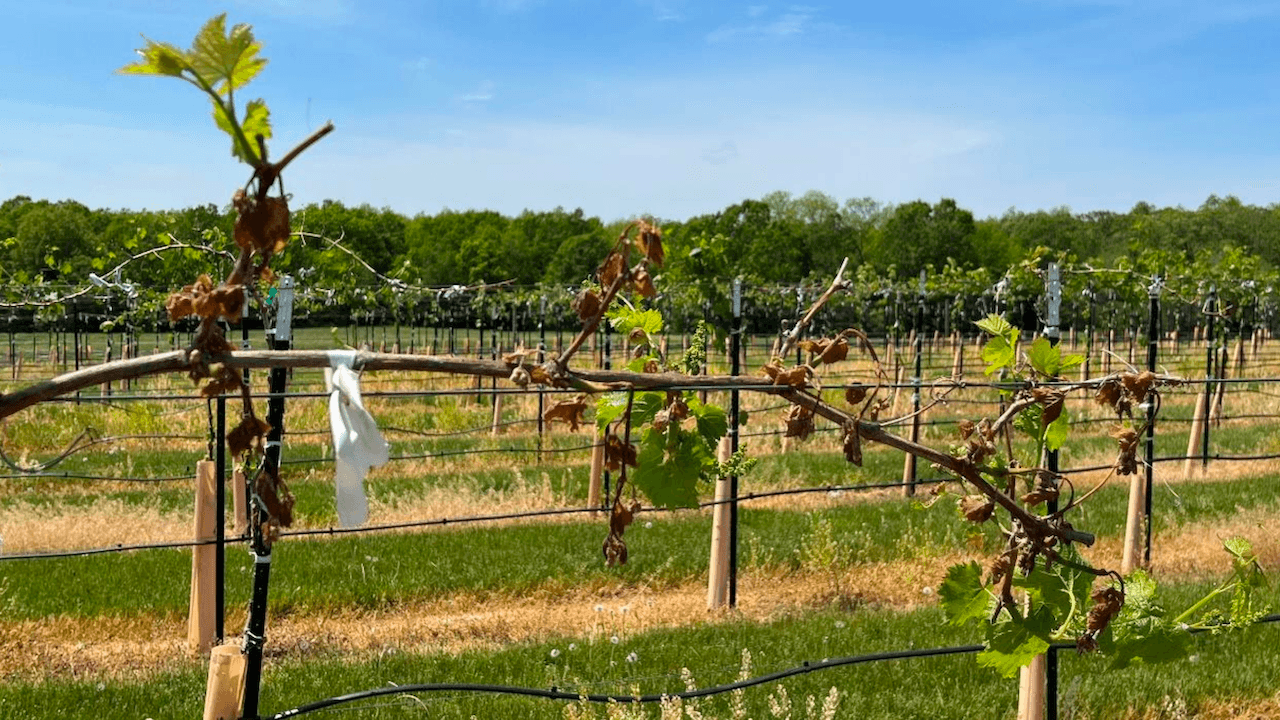
Grapevine shoot growth succumbed to below freezing temperatures on April 23 and 24, 2023 (Figure 3 & 4). These frost/freeze events negatively impacted most vineyards in Missouri (Table 3). Developing shoot growth was killed by air temperatures below 32 oF (Figure 6 (above)). Some vineyards escaped damage based on site selection. Whereas some grape cultivars in northern areas of Missouri had remained dormant and green tissue was not exposed to cold temperatures. In some southern counties below freezing temperatures only occurred on April 23.

In summary, the 2023 wine grape vintage was negatively impacted by a number of abiotic stress factors. The 2022 drought likely started the demise of the 2023 wine grape crop. Grapes are produced on 1-year old wood and the fruitful buds are established in the previous growing season. Drought conditions are known to impact grape buds’ ability to attain cold hardiness. An early killing frost on October 18, 2022 completely eliminated the potential of grapevines to continue to store carbohydrates. Ideally grapevines need a full leaf canopy for 4 to 6-weeks after harvest to store carbohydrates. On October 18, 2022 not all vineyards had been harvested. Grape buds were then exposed to extreme cold conditions on December 22 and 23, 2022. These temperatures killed a high percentage of primary buds across a wide range of cultivars. As the 2023 grape vintage began to grow near mid-April, late-April frost events killed developing shoots throughout Missouri. I estimate production will likely be reduced by 60 to 70% of average. As an example, production will range from 1.05 to 1.4 tons/acre (based on an average production of 3.5 tons/acre). These yields will not cover production and harvest costs in 2023 (based on price/ton in 2022). — By Dean S. Volenberg, Viticulture Extension Leader, University of Missouri Grape & Wine Institute

Article By
Dean S. Volenberg
Viticulture Program Leader, University of Missouri Grape and Wine Institute
Dean Volenberg is Viticulture Program Leader and an Extension Assistant Professor in the Division of Plant Science and Technology at the University of Missouri, where he works with the Grape and Wine Institute. His applied research examines how canopy management, vine balance and integrated pest management affect grape quality, and he provides viticulture and winery extension throughout Missouri. He holds a Ph.D. in agronomy and an M.S. in horticulture from the University of Wisconsin.