
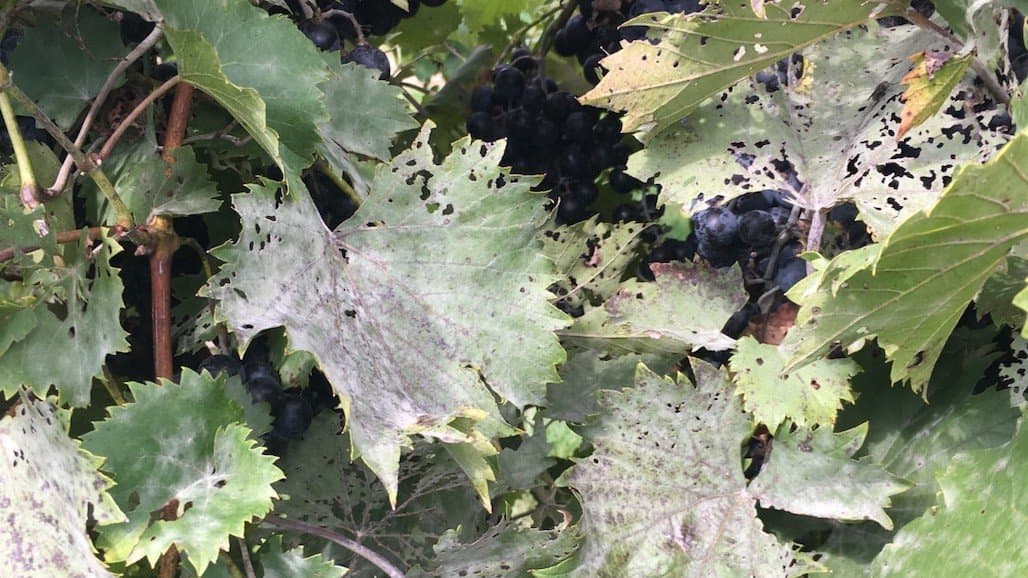
Oregon Wine Research Institute — Mid-July 2015 was the first time we saw indications of field level powdery mildew resistance to QoI (FRAC 11) and DMI (FRAC 3, myclobutanil, tebuconazole) fungicides. A few growers reported challenges managing mildew despite using fungicide spray programs that had been successful for many years. After eliminating the usual suspects–sprayer calibration, spray coverage, fungicide rate, neighbor impacts–we turned to look at fungicide resistance because many of these growers had DMI/QoI rotations beginning during bloom. We collected mildew samples from vineyards to evaluate if resistance was developing. After creating isolates, and phentotyping growth on leaves treated with fungicides, we found mildew populations resistant to both Qoi and DMI fungicides. More than 90% of mildew isolates had resistance to QoIs and 67% were resistant to both QoI and DMI fungicides.
In reality, concern about fungicide resistance began the year before, when we examined spore trapping data and noticed spore numbers in some fields were not decreasing after fungicide applications as expected. This prompted us to collaborate with Tim Miles’ group at Michigan State University to develop molecular assays to detect genetic markers for resistance from our spore trapping DNA. The combination of observations and data were the nexus of the FRAME Networks, a large collaborative USDA-AFRI-SCRI and OWB-funded project lead by Michelle Moyer at Washington State University and myself. Over the next 5 years, we demonstrated the utility of molecular tools to monitor for resistance mutations in vineyards, developed new molecular tools for detecting other resistance markers, increased our ability to phenotype resistant isolates, and sequenced the genome of the grape powdery mildew pathogen. As successful as the project was, it left us knowing that resistance would be a constant threat going forward.
Why the history lesson? Well, this year we are getting reports from Southern California growers struggling to control mildew with fungicide programs that worked since 2017. These spray programs rely heavily on SDHIs (FRAC 7) and Quinoxyfen (FRAC 13), thus there is concern that we could be seeing field scale resistance, though nothing is confirmed yet. These observations indicate that it is time to consider the potential for resistance SDHI and other fungicide classes being present in the powdery mildew population. The area in southern CA is where we first started seeing mutations associated with SDHI resistance (Stergiopulos et al 2022). We found several mutations associated with SDHI resistance occurring in the population from glove swab samples in 2019-2022 (Lowder et al, 2023). While we have no definitive data indicating field control failures due to SDHI resistance or other chemistries, it is a reminder to be diligent and keep an eye out for things that just don’t seem right. Things to watch for are disease pressure increasing year after year and proven programs not providing the expected amount of control.
While we are at it, don’t forget about Botrytis fungicide resistance. We found a fair bit of fungicide resistance in vineyard Botrytis populations located on grapevine debris that persists past bloom. We also found resistance to each of the registered fungicide chemistries for Botrytis in these populations. Unfortunately, many of these isolates had resistance to more than one fungicide group. Using DNA from our spore trapping work over the last 6 years, we overserved that Botrytis spores are always in the air but generally peak right around bloom. We also found resistant isolates in the vineyard debris and adjacent riparian areas. This means that you should rotate fungicide class for every Botrytis application including across growing seasons (e.g., do not use the same FRAC group for the last application in the fall in the first two applications of the next season, it would be best not to use it at all). It is important to remember that Botrytis fungicide applications are particularly important at bloom, as that is when the presence of botrytis spores peaks and flowers debris are highly susceptible to colonization. However, actual berry infection and symptom development does not occur until bunch closure or later, leading many to think infection happens much later, when the critical time is bloom. — By Walt Mahaffee, USDA Agricultural Research Service, Hort. Crops Disease and Pest Management Research Unit, Corvallis, OR
If you suspect fungicide resistance in your vineyards, please do not hesitate to reach out to walt.mahaffee@usda.gov. We are always glad to take a look.
References
Lowder SR, Neill TM, Peetz AB, Miles TD, Moyer MM, Oliver C, Stergiopoulos I, Ding S, Mahaffee WF. 2023. A rapid glove-based inoculum sampling technique to monitor Erysiphe necator in commercial vineyards. Plant Disease 107:3096–3105. DOI: 10.1094/PDIS-02-23-0216-RE.
Stergiopoulos I, Aoun N, van Huynh Q, Neill T, Lowder SR, Newbold C, Cooper ML, Ding S, Moyer MM, Miles TD, et al. 2022. Identification of putative SDHI target site mutations in the SDHB, SDHC, and SDHD subunits of the grape powdery mildew pathogen Erysiphe necator. Plant Disease 106:2310–2320. DOI: 10.1094/PDIS-09-21-1993-RE.